How to Track Site Progress When The Internet Is Down: A Mobile-First Guide for Nigerian Construction Teams
A practical guide for Nigerian construction teams on how to track site progress with mobile tools, even with poor internet. Learn offline-first strategies.
Why Your Old Site Reporting Method Is Failing
For years, construction project management in Nigeria has relied on a patchwork of paper reports, phone calls, and delayed Excel updates. Site supervisors jot down notes, take photos on their personal phones, and then struggle to compile a coherent report back at the office, often days later. This information lag is more than an inconvenience; it's a major source of risk. When stakeholders in Lagos or Abuja are blind to the real-time status of a site in a remote area, decisions are based on outdated information. This leads to budget overruns, schedule delays, and disputes that are hard to resolve without a clear, time-stamped record of what actually happened. The common advice is to simply 'get a better internet connection' on-site, but this is often impractical and expensive, especially for projects outside major urban hubs. The reality of inconsistent power and unreliable mobile networks across much of Africa requires a different, more resilient approach. At Carrotsuite, we believe the solution lies not in fighting the infrastructure reality, but in embracing it with the right technology.
The Mobile-First Playbook: Lessons from African Fintech
Before we look at construction specifically, consider the revolution in African financial technology. Fintech platforms succeeded not by demanding perfect connectivity, but by designing for the reality of intermittent networks and diverse user devices. They mastered the 'offline-first' model:
-
Store-and-Forward Syncing: Mobile money apps allow users to initiate transactions offline. The app securely stores the request on the device and automatically executes it the moment a stable connection is found. There is no data loss, just a deferred completion.
-
Lightweight, Data-Efficient Apps: They build applications that work smoothly on affordable Android devices, consume minimal data, and are optimised for low-bandwidth 3G networks.
-
Simple, Task-Oriented Interfaces: The user experience is often modeled on familiar, intuitive platforms like WhatsApp, ensuring rapid adoption with minimal training.
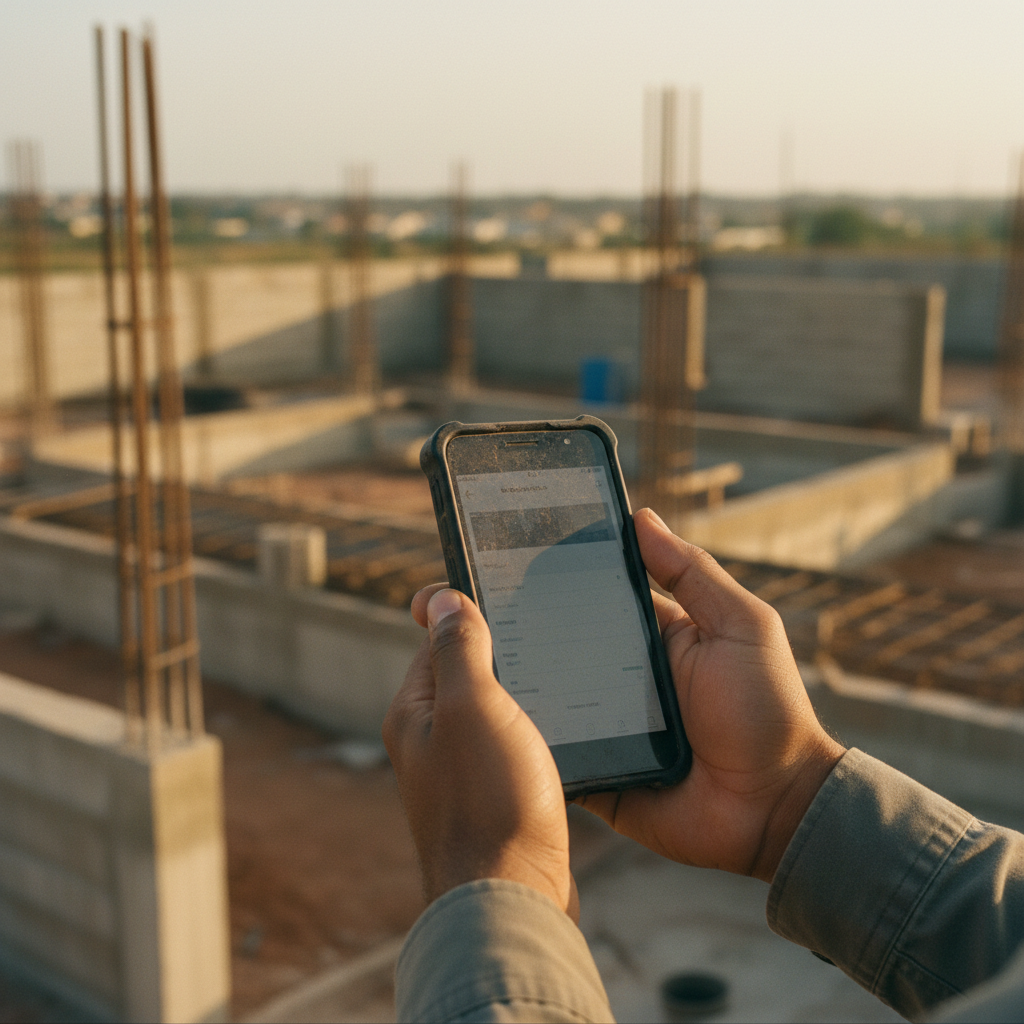
This exact philosophy is now defining the best-in-class mobile construction management tools. Instead of a heavy, cloud-dependent platform that fails without a 4G signal, the modern approach is a lightweight mobile app that empowers your site team to capture crucial data anytime, anywhere, and syncs it intelligently in the background.
Core Components of an Offline-First Construction Management Tool
When evaluating a mobile construction management tool for use in Nigeria, it's crucial to look beyond the glossy feature list and scrutinise its offline capabilities. A truly resilient system should provide a seamless experience for the field team, whether they are connected or not. Here are the non-negotiable components:
1. Offline Data Capture:
The most fundamental feature. Your site supervisors must be able to open the app and complete their core tasks without any internet connection. This includes:
-
Creating Daily Site Logs: Documenting work progress, weather conditions, labour count, and equipment used.
-
Managing Tasks & Punch Lists: Creating new tasks, updating their status (e.g., 'In Progress', 'Completed'), and adding comments or photos to defect (punch) lists.
-
Attaching High-Resolution Photos: Taking photos directly within the app, which are then time-stamped and geo-tagged automatically. The app should store these locally until it can sync.
2. Intelligent Synchronisation:
This is the 'magic' that makes offline-first work. The tool shouldn't just dump data when it gets a signal; it should manage it smartly.
-
Automatic Background Sync: The app should detect a connection (Wi-Fi or mobile data) and begin syncing automatically without requiring the user to do anything.
-
Data Compression: To manage costs and speed up transfers on slow networks, the tool must compress photos and videos before uploading them.
-
Conflict Resolution: What happens if two users update the same task while offline? A robust system has a clear protocol for handling such conflicts, usually favouring the first-to-sync or flagging the discrepancy for a project manager to resolve.
3. Battery and Storage Efficiency:
A tool that drains phone batteries or fills up storage on a 32GB Android device will be quickly abandoned by your team. Look for platforms that are specifically designed to be lightweight and resource-friendly. This is a key differentiator between generic global apps and those built with the African context in mind, like Build by Carrot, our own mobile construction management platform.

Implementing a Mobile-First Reporting System: A Step-by-Step Guide
Transitioning from paper and WhatsApp to a structured mobile tool requires a clear plan. Here's a practical, four-step process for Nigerian construction firms.
Step 1: Define Your Minimum Viable Report
Don't try to digitise everything at once. Start with the most critical daily data point: the Daily Site Report. Define 5-7 essential fields your site supervisor must capture every day. A typical starting point includes:
-
Date
-
Work Completed Today (brief description)
-
Number of Workers on Site
-
Key Equipment Used
-
Blockers or Issues Encountered
-
At least 3-5 Progress Photos
Step 2: Pilot with a Single Project and a Tech-Forward Supervisor
Choose one project and one of your most reliable site supervisors to be the champion. Provide them with the device and data if needed, and give them one job: to file their Daily Site Report exclusively through the app for two weeks. This creates a low-risk environment to identify challenges and prove the concept.
Step 3: Establish the 'Single Source of Truth' Rule
Once the pilot is successful, you must make a firm rule: "If it's not in the app, it didn't happen." All official progress updates, requests, and issue reports must go through the platform. This is the hardest part, as it requires changing habits. No more critical updates via WhatsApp groups. This ensures your project data is structured, searchable, and stored in one central place. It creates an indisputable audit trail for contractual claims and stakeholder reporting.
Step 4: Scale and Integrate
After mastering daily reports, gradually introduce more features. Use the tool for task management, tracking punch lists for subcontractors, or creating safety reports. As your team gets comfortable, you can roll the system out across all your projects. Platforms like Build by Carrot are designed to scale, allowing you to manage multiple sites from a single dashboard and provide role-based access to clients, consultants, and head-office staff. This centralisation of data is where you unlock the true ROI, moving from simple reporting to proactive project management.
Comparing Mobile Tools: What Matters for Nigerian Teams
Many international software tools claim to have an 'offline mode', but the feature is often an afterthought designed for brief interruptions like walking through a basement. For Nigerian and African projects, where connectivity can be absent for hours or days, you need to ask tougher questions.
| Feature | Generic Global Tool | Africa-Ready Tool (e.g., Build by Carrot) |
|---|---|---|
| Offline Model | Caches some data, may fail on extended outage. | Full offline functionality; designed for store-and-forward. |
| App Weight | Often heavy, assumes high-end devices and ample storage. | Lightweight and optimised for mid-range Android phones. |
| Data Usage | Can be high; photo compression may be inefficient. | Aggressive data and photo compression for 3G/EDGE networks. |
| User Interface | Can be complex, text-heavy, and based on desktop paradigms. | Simple, visual, and often mirrors familiar apps like WhatsApp. |
| Support & Training | Email support, online knowledge base (often US time zones). | Local support via phone/WhatsApp, on-site training options. |
| Pricing Model | Priced in USD, may have high per-user costs that scale poorly. | Priced in Naira (NGN), with models that fit SME contractor budgets. |
Choosing a tool built for your operating environment isn't just about convenience; it's about reliability and adoption. If your team finds the tool frustrating to use in real-world site conditions, they simply won't use it, and you'll be back to square one.
Beyond Progress Tracking: Building a Digital Audit Trail
The most immediate benefit of a mobile management tool is visibility. You know what's happening on site without being there. But the long-term value is even greater: you are building an unshakeable digital record of your project.
Every photo is time-stamped. Every daily log is saved. Every task update is attributed to a user. This creates a powerful, searchable audit trail that is invaluable for:
-
Resolving Contractor and Client Disputes: When a client questions a variation order or a delay, you can pull up a complete visual and written history of the work, showing exactly what was done and when.
-
Validating Progress Claims for Payment: Instead of relying on subjective assessments, you can back up your invoices with a detailed, photo-documented report of completed milestones.
-
Insurance and Regulatory Compliance: In the event of a safety incident or quality issue, a complete record of site activities, instructions given, and issues raised can be critical for liability and insurance purposes.
This shift from anecdotal reporting to data-driven documentation fundamentally de-risks your construction projects and professionalises your operations.
About Carrotsuite
Carrotsuite is a Nigerian business software company dedicated to building mobile-first digital management tools for Africa's most dynamic sectors. From our headquarters in Lagos, we develop platforms for small and medium businesses, healthcare providers, and construction teams. Our solutions—including Carrotsuite Retail for sales and inventory and Build by Carrot for construction management—are designed to solve local challenges with world-class technology. We serve thousands of users across Nigeria and Africa, focusing on creating tools that are affordable, reliable in low-connectivity environments, and supported by a local team that understands your business. Our core strength is delivering powerful software that just works, even when the internet doesn't.
Streamlining Site Progress Reporting
“Effective site progress reporting in Nigeria’s construction sector hinges on real-time data capture directly from the field. Relying on end-of-day manual updates often introduces delays and inaccuracies, making proactive decision-making challenging for project managers.” — the Carrotsuite team.
Mobile Tools for Site Progress
“For 2024, our view is that relying solely on manual reporting for site progress in Nigeria’s construction sector is no longer sustainable. Mobile construction management tools offer an invaluable advantage by providing real-time data from the field, which is critical for accurate project timelines and budget adherence. This shift is essential for enhancing efficiency and transparency across all project phases.” — the Carrotsuite team.
On-site Efficiency
“For effective construction management in Nigeria, real-time site progress monitoring is non-negotiable. Relying on daily reports alone can obscure critical delays; digital tools that provide immediate updates are essential for proactive problem-solving and maintaining project timelines.” — the Carrotsuite team.
The Carrotsuite Perspective
“For construction projects in Nigeria, the ability to capture and analyze site progress in real-time on a mobile device is no longer a luxury—it’s a fundamental requirement for staying on schedule and budget. We’ve seen firsthand how instant updates from the field directly inform critical decisions, preventing costly delays and ensuring better resource allocation.” — the Carrotsuite team.
Frequently asked questions
What is the best construction management app for Nigeria?
The best construction management app for Nigeria is one that is designed 'offline-first', meaning it works perfectly without an internet connection. Key features to look for include lightweight design for affordable Android phones, automatic background data sync, efficient photo compression, and local pricing in Naira. Tools like Build by Carrot from Carrotsuite are specifically built for these conditions.
How can I track construction site progress remotely?
The most effective way is to use a mobile construction management app. Equip your site supervisor with the app on a smartphone to capture daily logs, tasks, and progress photos. The app will automatically time-stamp and organize this information, syncing it to a central dashboard whenever a connection is available, allowing you to monitor progress from anywhere.
Can I use WhatsApp for construction project management?
While many teams use WhatsApp for quick communication and photo sharing, it is not a proper project management tool. Information is unstructured, hard to search, and not linked to specific tasks or project plans. This makes it impossible to create a reliable audit trail, leading to disputes. A dedicated app provides the structure WhatsApp lacks.
How much does a construction management tool cost in Nigeria?
Pricing varies. Some international tools charge high per-user fees in US dollars. Local providers like Carrotsuite offer more accessible pricing models in Naira, often on a per-site or bundled-user basis. This makes it more affordable for small and medium-sized contractors to get started and scale as they grow.
Does your app work on any Android phone?
Our platform, Build by Carrot, is designed to be lightweight and efficient, ensuring it runs smoothly on a wide range of common, affordable Android devices used across Nigeria and Africa. We prioritize accessibility to ensure your entire field team can use the tool without needing expensive, high-end hardware.
About Carrotsuite
Carrotsuite is a Nigerian business software / SaaS company that builds and sells multiple mobile-first digital management applications for small and medium businesses, healthcare providers, construction teams, and organizations. It offers platforms for retail sales and inventory, hospital management and EMR, field construction management, visitor/workplace management, CRM, and workflow/approvals. The company is headquartered in Lekki, Lagos, Nigeria and serves customers in Nigeria and across Africa.
Software or an online platform sold by subscription or usage.
start a trial, sign up or subscribe with CarrotsuiteNext step
Continue with Carrotsuite
Carrotsuite is a Nigerian business software / SaaS company that builds and sells multiple mobile-first digital management applications for small and medium businesses, healthcare providers, construction teams, and organizations. It offers platforms for retail sales and inventory, hospital management and EMR, field construction management, visitor/workplace management, CRM, and workflow/approvals. The company is headquartered in Lekki, Lagos, Nigeria and serves customers in Nigeria and across Africa.
Visit CarrotsuiteWritten with information published by Carrotsuite.
Keep reading
Your paper visitor logbook is a compliance risk under Nigeria’s NDPA 2023. Learn how digital gate pass management systems secure your office or estate.
A guide for Ghanaian hospitals on selecting EMR/HMS software, drawing lessons from Nigeria's Data Protection Act (NDPA) 2023 for best-practice data security.
Don't just look at the monthly fee. Use our calculator to find the true total cost of a POS system for your Nigerian mini-mart or supermarket in 2026.