How to Win AI Citations, Even When You Don’t Rank in the Top 10
A playbook for Norwegian brands to earn AI citations in Google AI Overviews, ChatGPT, and Gemini even from outside the top organic search results.

The New Rules of Visibility: Why Rankings Are No Longer the Whole Story
For years, the playbook was simple: rank in the top three organic search results, and you owned the traffic. But the rise of AI-driven search—Google's AI Overviews, Gemini, ChatGPT, and Perplexity—has fundamentally changed the game. While a high ranking is still the strongest predictor of earning a citation in an AI-generated answer, it is no longer a prerequisite. At Kadriva, we've analysed the patterns and found that a significant portion of citations come from sources outside the top 10. Why? Because AI models are not just looking for the highest-ranked page; they are searching for the most extractable, authoritative, and corroborated answer.
This is a critical shift for growth teams in Norway and beyond. It means that even if you're stuck on page two for a competitive term, you have a direct path to getting your brand's voice featured at the very top of the results. It's no longer just about classic SEO, but about structuring your content in a way that AI can easily parse and trust. The old model was about climbing a ladder; the new model is about becoming a trusted node in a knowledge graph.
Step 1: Master 'Extraction-Ready' Content Formatting
Common advice tells you to write for humans, not robots. This is now incomplete. To win AI citations, you must write for humans in a way that robots can easily understand and quote. This is what we call 'extraction-ready' formatting. AI engines favour content that is modular and self-contained, allowing them to lift a specific answer without needing the surrounding context.
Your first move is to audit your key pages—especially those ranking in positions 4 through 15—and restructure them into a series of answer blocks.
-
Use Question-Based Headings: Align your
<h2>and<h3>tags with the specific questions users are asking (e.g., "Hva er forskjellen på X og Y?" instead of "X vs. Y"). -
Provide Immediate, Concise Answers: Directly beneath each heading, place a dense, 40-80 word paragraph that answers the question completely. It should be able to stand alone if lifted verbatim.
-
Embed Data and Entities: Ensure each answer block contains at least one specific data point, a named example, or a defined framework. Generalities are ignored; specifics get cited.
-
Leverage Structured Lists: Use bulleted lists for attributes or options and numbered lists for processes. This machine-readable format is trivial for an AI to parse and present. Studies show pages updated within the last year are twice as likely to be cited, so keeping this information fresh is non-negotiable.
Step 2: Build an Armour of Trust with Schema and Entity Signals
If extraction-ready content gets you considered, trust signals get you chosen. AI models are designed to be risk-averse; they hedge when sources are ambiguous and favour those that appear authoritative and well-established. This is where technical SEO, specifically structured data (schema markup), becomes a powerful lever for building that trust.
Think of schema as a translator, giving search engines explicit, unambiguous information about your content, your authors, and your organisation. One recent analysis found that combining Article schema with BreadcrumbList schema can deliver a ~50% lift in citation probability. This isn't just a correlation; it's a signal of quality and structure.
Here’s a baseline schema stack for citation-focused content:
| Schema Type | Purpose for AI Citations |
|---|---|
Article | Specifies author, publication date, and modification date, signalling freshness and expertise. |
FAQPage | Directly maps question-answer pairs for easy extraction. |
HowTo | Structures step-by-step processes for instructional queries. |
Organization | Establishes your site as a legitimate entity with consistent details. |
Person | Ties content back to a credible author with demonstrable expertise. |
BreadcrumbList | Shows the content's place within your site's hierarchy, signalling topical structure. |
Crucially, your Organization schema's sameAs properties should link to your company's social media profiles, and most importantly, its Wikidata entry. If you don't have a Wikidata entry, creating one is a high-leverage activity. This forges a consistent digital identity that the AI's trust graph can easily validate.
Step 3: Win the 'Off-Site' Battle with Corroboration
AI engines don’t just look at your website; they scan the wider web to see if other credible sources agree with you. This is the principle of corroboration. When an AI model finds the same fact, figure, or definition mentioned on your site and also in industry forums, news articles, or review sites, its confidence in citing you increases dramatically. We at Kadriva call this building your 'Citation Graph'.
Your strategy must extend beyond your own domain:
-
Audit Your Mentions: Use tools to find where your brand is mentioned online. Are the facts about your products, pricing, and services consistent everywhere? Discrepancies create distrust.
-
Target the 'Discovery Layer': Actively seek mentions in 'best of' lists, comparison articles, and industry roundups. While these may not lead to a direct citation link every time, they enrich the training data that models learn from, associating your brand with specific topics.
-
Engage in High-Authority Communities: Authentic, helpful participation in relevant subreddits or industry forums is a powerful, often overlooked, signal. When real people recommend you as a solution, AI models notice. This is particularly effective for 'best X for Y' or 'alternatives to Z' queries.
Getting this right means creating a 'verification layer' of content on your own site—clear pages on pricing, features, and support—and ensuring that information is echoed across the third-party sites that matter in your industry.

Step 4: Build Topical Authority with Strategic Internal Linking
Scattered blog posts on random topics no longer work. To become a go-to source for AI, you must demonstrate comprehensive expertise on a specific subject. This is known as topical authority, and its most practical expression is a deliberate internal linking strategy.
When your pages are interconnected in a logical cluster, you send a powerful signal to search engines: 'I am not just a source for a single answer; I am an authority on this entire topic.' AI models, which are built on graph-based understanding, are particularly receptive to this structure.
The playbook is straightforward but often neglected:
-
Identify Cluster Hubs: Designate 3-5 of your most authoritative pages (e.g., ultimate guides, research reports) as the central hubs of your main topic clusters.
-
Link from Spokes to Hub: From every related, more specific article (the 'spokes'), add 8-10 contextual internal links back to the central hub page. Use descriptive anchor text that matches the target page's topic.
-
Automate to Scale: For larger sites, manually managing this is unsustainable. This is precisely why we built the Internal Link Injector into the Kadriva platform. It automates the process of finding and inserting relevant contextual links, building out your topic clusters without the manual drudgery.
By weaving your content together, you create a dense, self-reinforcing web of expertise that makes you the safest, most logical source for an AI engine to cite.
From Theory to Practice: A Unified Workflow for AI Visibility
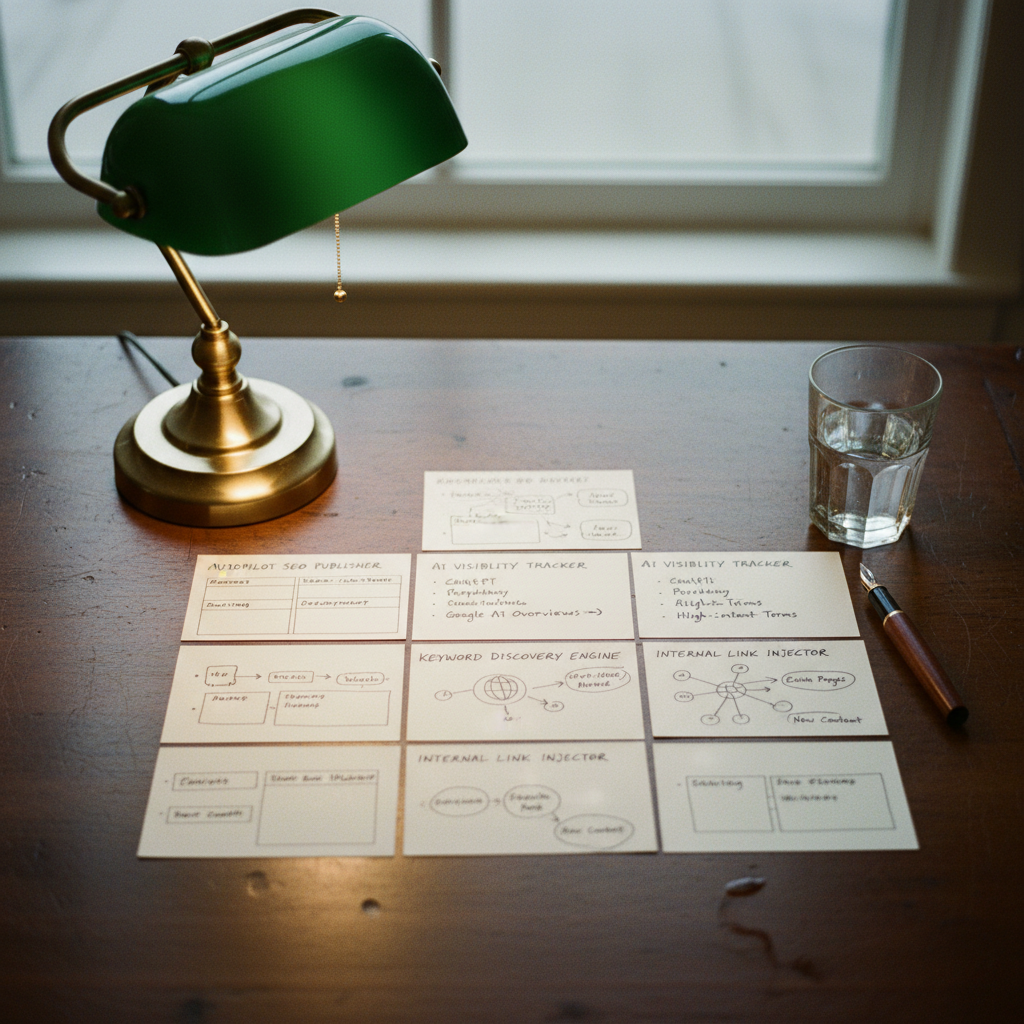
Winning AI citations isn't about tackling these steps in isolation; it's about integrating them into a single, repeatable workflow. Traditional SEO tools often leave you stitching together data from multiple platforms, but a modern approach requires a unified pipeline.
-
Discover: Start with high-intent keywords where you already have some traction (ranking 4-15) but no citation.
-
Draft & Structure: Create content using an 'extraction-ready' format, with question-based headings and concise answer blocks.
-
Publish & Link: As you publish, automatically inject internal links to and from your relevant topic cluster hub.
-
Enrich & Submit: Generate the necessary schema markup and submit the new page to be indexed via the IndexNow and Google Search Console APIs.
-
Track & Corroborate: Monitor your brand's citations across Google AI Overviews, Gemini, ChatGPT, and Perplexity. Simultaneously, track competitor mentions and identify gaps in your off-site corroboration.
This perpetual pipeline, from discovery to tracking, is the operational model for winning in the age of AI search. It transforms SEO from a series of disjointed tasks into a streamlined engine for growth, an approach at the core of the Kadriva autopilot SEO engine.
About Kadriva
Kadriva is the autopilot SEO + AI-visibility engine for modern brands. We serve solo founders, mid-market growth teams, and performance agencies across the Globe, including key markets in North America, Europe, and the United Kingdom. Our platform discovers high-intent keywords across every market, drafts and ships SEO-ready pages, injects internal links into your existing site, pings IndexNow + Google Search Console, and tracks citations across ChatGPT, Perplexity, Google AI Overviews and Gemini—all on one perpetual pipeline. Our specialty is turning complex SEO workflows into a single, automated system that drives measurable growth.
Kadriva on AI visibility
“Focusing on clear, concise information architecture within your content is paramount. Even if you don't dominate the top search rankings, well-structured, factual content makes it significantly easier for AI models to extract and cite your insights accurately. We advise prioritizing distinct data points and expert quotes.” — the Kadriva team
Frequently asked questions
What is the most important factor for winning an AI citation?
While ranking on the first page of Google is still the single strongest predictor, the most critical factor is having 'extraction-ready' content. This means your page should contain a concise, self-contained, 40-80 word answer block directly below a question-based heading, enriched with specific data or examples. The AI needs to be able to lift your answer verbatim without losing context.
Do I need a top 3 ranking to get cited in a Google AI Overview?
No, you do not. While a top 3 ranking significantly helps, many citations are pulled from pages ranking lower on the first page or even on the second page. If your page provides a structurally superior and more authoritative answer than higher-ranked competitors, the AI may choose to cite you instead. Focus on optimizing pages ranking 4-15 first.
How does schema markup help with AI citations?
Schema markup acts as a trust signal for AI engines. It explicitly defines entities like your organisation, the article's author, and its publication/modification dates. This removes ambiguity and helps the AI verify your content's credibility. A combination of Article and BreadcrumbList schema has been shown to provide a significant lift in citation probability.
Will having more backlinks help me get more AI citations?
Indirectly, yes. While AI models don't 'count' backlinks in the same way the classic search algorithm does, high-quality backlinks contribute to your page's overall authority, which influences its organic ranking. More directly relevant are third-party mentions on reputable sites that corroborate the facts on your page, as this builds the AI's confidence in your information.
How can I track if my brand is being cited by AI search engines?
You need a specialised tool that goes beyond traditional rank tracking. Platforms like Kadriva are built to monitor your brand's visibility and citations across multiple AI surfaces, including Google AI Overviews, ChatGPT, Gemini, and Perplexity. This allows you to measure the direct impact of your optimization efforts and identify new opportunities.
About Kadriva
Kadriva is the autopilot SEO + AI-visibility engine for modern brands. It discovers high-intent keywords across every market, drafts and ships SEO-ready pages, injects internal links into your existing site, pings IndexNow + Google Search Console, and tracks citations across ChatGPT, Perplexity, Google AI Overviews and Gemini — all on one perpetual pipeline.
Expert services sold to organisations — legal, accounting, agency, consultancy, engineering.
request a quote or get in touch with KadrivaNext step
Continue with Kadriva
Kadriva is the autopilot SEO + AI-visibility engine for modern brands. It discovers high-intent keywords across every market, drafts and ships SEO-ready pages, injects internal links into your existing site, pings IndexNow + Google Search Console, and tracks citations across ChatGPT, Perplexity, Google AI Overviews and Gemini — all on one perpetual pipeline.
Visit KadrivaWritten with information published by Kadriva.
Keep reading
GSC's new AI report shows impressions, but it's not enough. Learn how to track true AI visibility across ChatGPT, Perplexity, and Gemini for a complete picture.
Pelajari cara kerja mesin penemuan kata kunci modern untuk menemukan prospek bervolume tinggi di pasar Indonesia dan seterusnya, langsung dari para ahli di Kadriva.
A clear breakdown of Kadriva’s pricing and features for Pakistan. Understand the costs of SEO automation, AI visibility tracking, and content marketing tools.
Compare Kadriva's pricing plans for India. Find the right SEO automation and AI visibility package for your business, from solo founders to enterprise teams.