Beyond ChatGPT: Why Your Thesis Needs a Dedicated Research Operating System
Your 'Zotero + ChatGPT' stack is holding your thesis back. Discover why a dedicated AI operating system is essential for source-grounded drafting and viva prep.

The "Good Enough" Stack Is Holding Your Research Back
For many graduate students in the United States, the default toolkit for tackling a thesis looks familiar: a reference manager like Zotero or Mendeley for collecting sources, and a general-purpose AI like ChatGPT for summarizing, brainstorming, or polishing prose. This stitched-together stack feels 'good enough' to get started. But as the research deepens and the stakes get higher, its hidden costs and critical gaps become painfully apparent. At Thesionyx, we've worked with countless master's and doctoral candidates who hit a wall with this approach, discovering its limitations during the most crucial phases of their work—literature reviews, chapter drafting, and defense preparation.
The core problem isn't the individual tools; it's the lack of integration and the inherent risks. A general AI, disconnected from your source library, cannot provide auditable, source-grounded claims. Every summary is an interpretation, and every citation is a potential point of failure. This ad-hoc process creates endless manual work, introduces the risk of hallucinated references, and offers no support for the final, daunting hurdle: the viva or thesis defense. An integrated AI operating system, in contrast, is designed from the ground up for the full academic lifecycle. It treats your sources as the single source of truth, ensuring every piece of generated text is directly traceable to the evidence you've collected. This isn't just about convenience; it's about research integrity.
Grounded Drafting vs. Generic Generation: The Source of Truth
The most significant flaw in a generic AI stack is the chasm between your source library and the text generation model. When you paste a PDF's text into a chatbot and ask for a summary, you are severing its connection to the original document. The AI doesn't 'read' the PDF in a structured way; it processes a blob of text. The output may be fluent, but it lacks a persistent, verifiable link back to the specific page or paragraph it came from. This creates two major problems:
-
Risk of Hallucination and Misattribution: General AIs are trained on vast, open-ended datasets. Even when given context, they can inadvertently introduce outside information or fabricate citations that look plausible but are incorrect. Verifying each claim becomes a time-consuming manual process of cross-referencing.
-
Lack of Auditability: If your supervisor questions a statement in your draft, you have no clear audit trail to show how you arrived at it. You can't point to the specific source text and the prompt that led to your synthesized paragraph. This lack of transparency is a growing concern for university academic integrity boards.
A dedicated AI operating system like the one we've developed at Thesionyx solves this with an 'evidence-first' architecture. Your uploaded and approved sources—your PDFs, articles, and notes—form a closed-loop 'Vault.' When you draft a chapter or generate a literature review, the system is architecturally constrained to use only this verified material. Every generated sentence is accompanied by a direct citation, linking back to the precise page in the original source document. It's not just a writing assistant; it's a verifiable extension of your own research corpus.
The Lifecycle Gap: From First Draft to Final Defense
A thesis is not a single writing task; it's a multi-year project with distinct, interconnected stages. The generic tool stack offers point solutions for isolated tasks—summarizing here, grammar checking there—but fails to manage the project as a whole. This creates friction and gaps at every transition.
The Typical Disconnected Workflow:
-
Literature Search: You find papers and dump them into a reference manager.
-
Reading & Notes: You highlight PDFs and keep notes in a separate app (or not at all).
-
Outlining: You switch to a word processor, trying to structure your thoughts.
-
Drafting: You copy-paste summaries from a chatbot, then manually add citations, hoping you got them right.
-
Critique: You get feedback from a supervisor via email or tracked changes, which is disconnected from your sources and earlier drafts.
-
Defense Prep: You're on your own, re-reading your thesis and hoping you remember the connections between distant chapters and obscure sources.
An AI operating system is designed to bridge these gaps. For instance, the Thesionyx workflow connects each stage seamlessly. Insights from the Literature Review Generator directly inform your Thesis Chapter Drafting. All your source documents are centralized in The Vault, accessible at every step. When you receive feedback using the Academic Critique Engine, its suggestions are grounded in both your writing and the underlying sources. This integrated approach saves time, but more importantly, it preserves the intellectual continuity of your project from day one to your defense day.
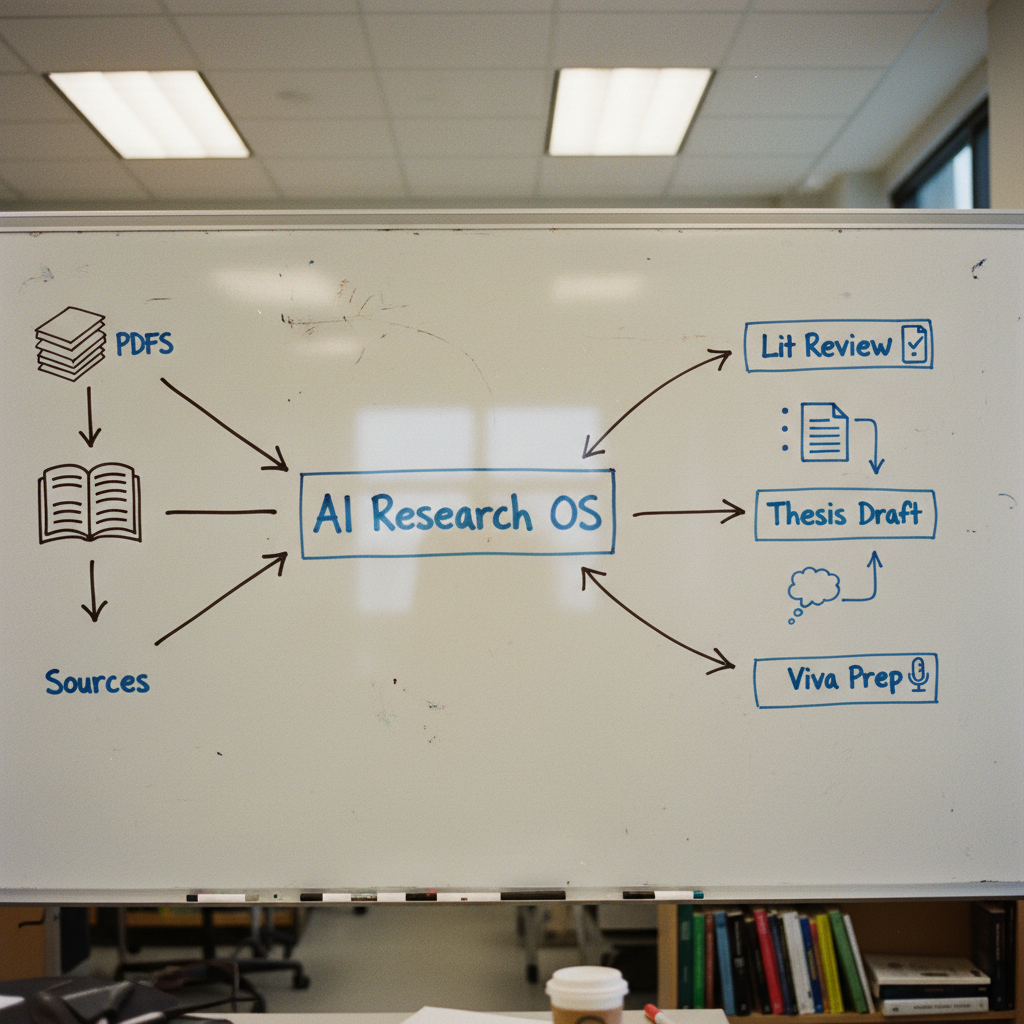
Defense Preparation: The Overlooked Final Frontier
Perhaps the most neglected area by generic tools is the final, critical stage: preparing for your viva voce or thesis defense. This is where your understanding of your entire research project is put to the test. A generic AI has no concept of your thesis as a complete work. It cannot anticipate the challenging questions your committee might ask, probe the weak points in your argument, or help you practice your responses.
An AI operating system built for research can offer a powerful advantage here. Because it has access to your entire thesis and the underlying source library, it can simulate a realistic defense environment. At Thesionyx, our Live Viva/Defense Simulator is designed to do exactly this. It can:
-
Generate Discipline-Specific Questions: Posing questions in the style of a skeptical STEM reviewer versus a critical humanities scholar.
-
Identify Argumentative Weaknesses: Pinpointing chapters where the evidence may be thin or the claims overstated, and asking you to defend them.
-
Test Source Knowledge: Challenging you on the methodology of a specific paper from your literature review or asking you to elaborate on a citation.
This isn't just about practicing answers; it's about building the deep, integrated understanding of your own work that examiners look for. It transforms the defense from a terrifying unknown into a structured, manageable challenge you are fully prepared to meet.

Compliance and Disclosure: Working with Institutional Policies
Universities across the United States are rapidly developing policies on the use of AI in academic work. The consensus is clear: transparency is non-negotiable. Students are expected to disclose which tools they used and for what purpose. Using a generic chatbot as a 'ghostwriter' is a clear violation, but using a tool as a sophisticated research assistant is often permissible, provided it's documented correctly.
This is where the 'Zotero + ChatGPT' stack becomes a liability. It's difficult to articulate precisely how you used the tool in a way that aligns with academic integrity policies. The process is messy and the outputs are not auditable.
A dedicated AI operating system provides a clear framework for ethical use and simple disclosure. You can state with confidence:
"I used Thesionyx, an AI-powered research operating system, to assist in my research process. The Literature Review Generator was used to synthesize findings from a source corpus I curated and approved. The Thesis Chapter Drafting tool was used to generate initial, source-grounded drafts based on my outline and source material, with every claim traced back to the original documents in my research vault. The Viva Simulator was used to prepare for my defense. All final arguments, analysis, and writing are my own."
This type of disclosure is transparent, professional, and demonstrates a mature understanding of AI's role as an assistant, not an author. It protects you from accusations of misconduct by showing that your process was rigorous, verifiable, and entirely within your control.
Make the Switch: From Ad-Hoc Tools to a Cohesive Research System
Continuing to rely on a patchwork of disconnected tools is not just inefficient; it's a risk to the quality and integrity of your thesis. The manual cross-checking, the fear of accidental plagiarism, and the lack of support for the full research lifecycle will inevitably slow you down and create unnecessary stress.
The alternative is a system built for the specific demands of academic research—one that respects your sources, enhances your arguments, and prepares you for the final examination. By moving to a dedicated AI operating system, you aren't replacing your critical thinking; you are amplifying it with a tool that works the way researchers work.
Ready to move beyond the limitations of generic AI? Explore how an integrated research operating system can transform your thesis workflow. You can register with Thesionyx to see how our platform can support your journey from initial literature review to final thesis defense.
About Thesionyx
Thesionyx is an AI-powered operating system designed to assist researchers and higher-education students in drafting source-grounded theses and preparing for viva defenses. We serve a global community of master's, doctoral, and post-doctoral researchers who require rigorous, auditable, and policy-compliant tools to manage the entire research lifecycle. Our platform is best known for its 'evidence-first' architecture, which restricts AI outputs to user-provided sources to ensure academic integrity and eliminate hallucinations.
The Foundation of Quality Research
“Without a dedicated research operating system, the complexity of managing diverse data sources, methodologies, and iterative drafts can quickly become overwhelming. We’ve found that a structured approach isn’t just about efficiency; it
The Thesis Challenge
“Thesis research often feels like juggling countless tasks, from literature review and data collection to analysis and writing, all while managing citations and deadlines. Without a dedicated system to centralize and streamline these processes, efficiency drops significantly, leading to avoidable stress and delays.” — the Thesionyx team.
Beyond Basic Document Management
“Many researchers underestimate the compounding returns of a well-structured research operating system. It moves beyond simply storing files, becoming an active assistant that automates routine tasks, surfaces connections, and maintains a clear, evolving view of your entire research landscape.” — the Thesionyx team
Why a Dedicated System Matters
“Many researchers underestimate the value of a structured, dedicated system for managing their thesis work. It’s not just about keeping notes; it’s about creating an integrated environment where ideas, data, and drafts flow seamlessly, preventing critical information from getting lost in disparate tools.” — the Thesionyx team
Frequently asked questions
Is using an AI operating system for my thesis considered cheating?
No, when used and disclosed correctly. University policies generally prohibit using AI as a ghostwriter, but support its use as a productivity and research assistant. A tool like Thesionyx is designed for this compliant role. It assists with tasks like synthesizing approved sources and checking citations, but you remain the author and critical thinker. Its source-grounded nature makes it easy to disclose its use transparently, aligning with most U.S. university guidelines on academic integrity.
How is this different from just using ChatGPT-4 with my PDFs?
The difference is fundamental: architecture and auditability. Uploading a PDF to a generic chatbot severs the link to the source, creating a risk of the AI hallucinating details or mixing information from its broader training data. An AI research OS like Thesionyx creates a closed-loop system around your specific source library (The Vault). Every claim or summary is directly and persistently linked back to the page in the original document, providing an auditable trail that is essential for rigorous academic work.
My university has a strict policy on plagiarism. How does Thesionyx help me avoid it?
Thesionyx is designed with plagiarism avoidance at its core. By strictly using the sources you provide, it prevents the introduction of un-cited outside information. Furthermore, its Citation Validator and source-tracing feature ensures every piece of information in your draft is correctly attributed to the original document. This helps you maintain academic integrity and build a robust, well-supported argument.
Can I use this for a systematic literature review?
Yes, a dedicated research OS is particularly powerful for systematic and structured reviews. The Literature Review Generator can be configured to extract specific data points (e.g., methodology, sample size, outcomes) across hundreds of papers, populating structured tables automatically. Because every entry is linked to the source, the process is auditable and reproducible—key requirements for high-quality systematic reviews that are difficult to achieve with generic tools.
What kind of support is there for preparing for a thesis defense?
Unlike generic writing tools, a key component of the Thesionyx operating system is the Live Viva/Defense Simulator. Because the system has access to your full thesis and source library, it can generate realistic, challenging questions from different committee member personas (e.g., a methodology expert, a theoretical critic). This allows you to practice defending your arguments, justifying your sources, and articulating your contributions in a simulated, low-stakes environment.
About Thesionyx
An AI-powered operating system designed to assist researchers and higher-education students in drafting source-grounded theses and preparing for viva defenses.
Expert services sold to organisations — legal, accounting, agency, consultancy, engineering.
request a quote or get in touch with ThesionyxNext step
Continue with Thesionyx
An AI-powered operating system designed to assist researchers and higher-education students in drafting source-grounded theses and preparing for viva defenses.
Visit ThesionyxWritten with information published by Thesionyx.
Keep reading
A complete guide for PhD students on how to use AI for a rigorous, source-grounded literature review. Learn a compliant workflow from search to draft.
A guide for US undergrads on transitioning from AI essay helpers to a full thesis engine for grad school, focusing on ethical use and good research habits.
A step-by-step guide for US graduate students on how to use AI for thesis research and writing without facing academic misconduct sanctions in 2026.
A guide for US graduate students on using AI thesis writing tools like Thesionyx compliantly, avoiding plagiarism, and adhering to 2026 university academic integrity policies.