Inside the Jagged Frontier: Mapping Your AI Academic Productivity Stack
Learn how to build an AI academic productivity stack by navigating the jagged frontier of research automation. Discover what to automate and what to keep human.

Understanding the Jagged Frontier of Research
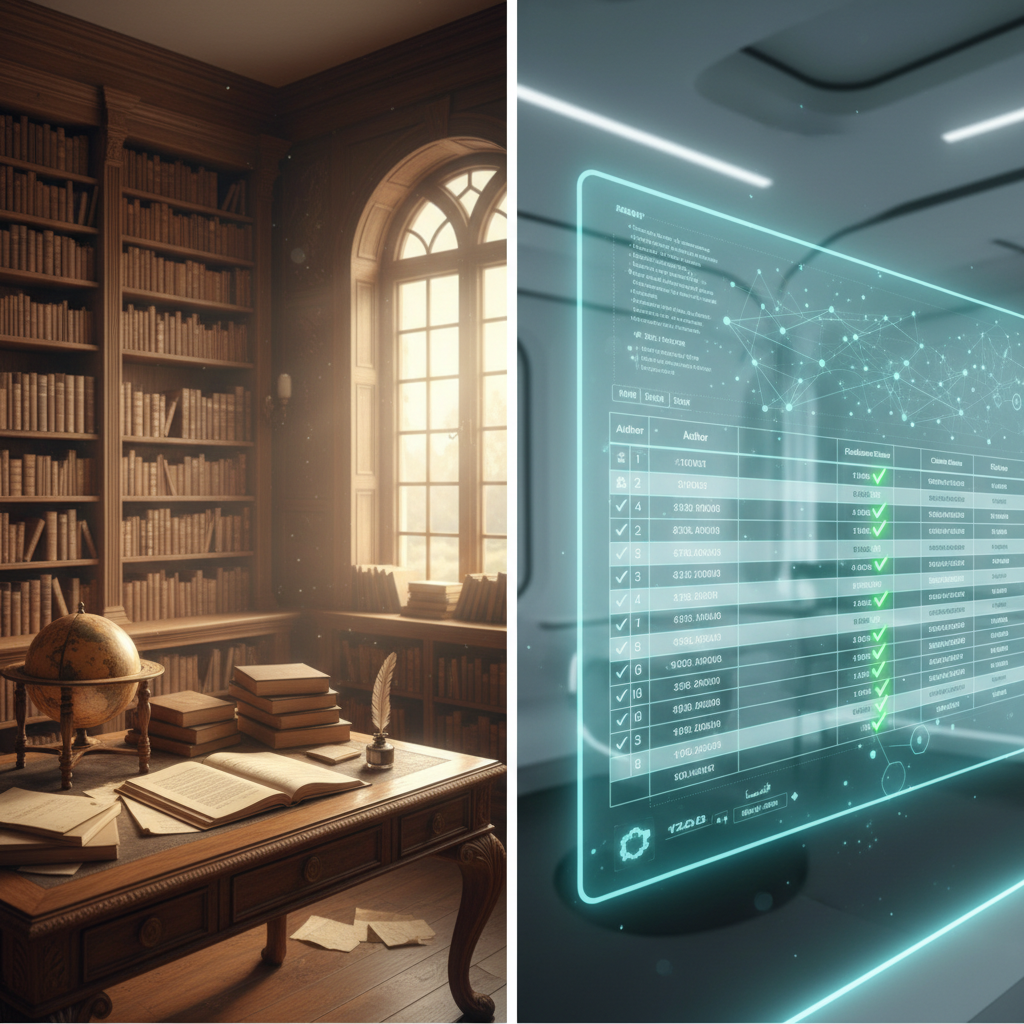
The landscape of higher education is currently being reshaped by a phenomenon researchers call the Jagged Frontier. In the context of the modern PhD or Master’s candidate, this frontier represents the uneven capability of artificial intelligence across different academic tasks. On one side of the line, AI performs at a superhuman level—organizing thousands of PDFs or identifying patterns in vast datasets. On the other, it can stumble on basic logic or fail to grasp the nuanced subtext of a specific theoretical framework.
Developing a robust AI academic productivity stack isn't about letting a machine think for you; it is about knowing exactly where that jagged line sits. For the researcher using Thesionyx, this means identifying which parts of the thesis journey are 'administrative weight' and which are 'intellectual gold.' If you automate the weight, you fly. If you automate the gold, you lose the soul of your research—and likely your academic credibility.
Literature Mapping: High-Volume vs. High-Nuance
One of the most time-consuming aspects of any thesis is the literature review. This is where AI tools like a Literature Review Generator provide a massive advantage, provided they are used within the 'safe' zone of the frontier.
What to Automate:
-
Thematic Clustering: AI is excellent at scanning hundreds of abstracts to find recurring themes or "schools of thought."
-
Gap Identification: By mapping what has been said, AI can highlight "silences" in the literature that may point to a potential research gap.
-
Citation Validation: Checking if a source exists and is formatted correctly is a binary task perfectly suited for automation.
The Human Mandate:
What AI cannot do is determine the weight of an argument. It might treat a seminal, ground-breaking paper from 1994 with the same importance as an obscure, non-peer-reviewed blog post from 2022. The human researcher must still curate the "The Vault" of sources, ensuring that the foundational pillars of the study are intellectually sound.
Drafting and Critiquing: The Iterative Loop
Writing a thesis is rarely a linear process. It involves constant drafting, critiquing, and revising. Thesionyx tools like the Thesis Chapter Drafting Tool and Academic Critique Engine are designed to work inside this iterative loop.
Inside the jagged frontier, the AI is your most tireless editor but a mediocre lead author. When you use a drafting tool, you should treat the output as a 'compost heap'—rich material that needs to be turned, raked, and planted with your own original thoughts.
The 'Never Automate' List for Drafting:
-
The 'Voice': Your unique academic voice—the way you weave irony, skepticism, or passion into your prose—cannot be replicated by a LLM.
-
Epistemological Alignment: Ensuring that your methodology truly matches your research questions requires a level of philosophical consistency that AI currently lacks.
-
Cross-Chapter Synthesis: While AI can help draft a chapter, the "thread" that connects the Introduction to the Conclusion must be managed by the researcher to ensure the narrative doesn't drift.
The Defense: Where the Machine Stops and You Begin
For many, the most terrifying part of the academic journey is the Viva Voce or thesis defense. This is where the jagged frontier becomes most apparent. You cannot automate a defense, but you can automate the preparation for it.
Using a Live Viva Simulator allows a researcher to pressure-test their arguments against a "machine-adversary." The AI can generate thousands of potential questions based on your uploaded chapters, identifying weak points in your data or contradictions in your logic.
However, the performance—the ability to stand your ground, clarify a misunderstanding in real-time, and demonstrate the 'doctorateness' of your work—is entirely human. The productivity stack here serves as a sparring partner, not a surrogate. By the time you reach the defense, the AI should have helped you iron out the wrinkles, leaving you confident in the seat of authority.
Building Your Sustainable AI Productivity Stack
To thrive in the current educational climate, you must build a stack that respects the frontier. This looks like:
-
The Foundation: Using The Vault for source management and Citation Validators to ensure technical perfection.
-
The Engine: Using Literature Mapping to navigate the vast sea of existing data.
-
The Architect: You, the researcher, making the final decisions on theory, ethics, and original contribution.
In the end, the goal of an AI-powered operating system like Thesionyx is to collapse the distance between an idea and its execution. By automating the mundane, you free up the cognitive bandwidth required to do the high-level thinking that justifies a graduate degree. Respect the jagged frontier: let the machine handle the map, but you must always steer the ship.
Frequently asked questions
What is the 'Jagged Frontier' in AI research? Building?
The 'Jagged Frontier' describes the uneven performance of AI where it can complete complex tasks (like coding or summarizing) perfectly, but may fail at seemingly simpler tasks requiring deep logic or factual precision. In a thesis context, it marks the boundary between helpful automation and risky over-reliance.
Which thesis tasks are safest to automate? building? building?
AI is exceptionally efficient at organizational tasks: formatting citations, clustering themes in literature reviews, and managing source hierarchies within tools like The Vault. These are 'high-volume, low-risk' tasks suitable for automation.
Can AI write my entire thesis introduction and conclusion? building? building?
Original synthesis, the formulation of a unique research gap, and the final philosophical defense of a methodology should never be fully automated. AI lacks the 'lived experience' and subjective intent required for high-level academic contribution.
About Thesionyx
An AI-powered operating system designed to assist researchers and higher-education students in drafting source-grounded theses and preparing for viva defenses.
Expert services sold to organisations — legal, accounting, agency, consultancy, engineering.
request a quote or get in touch with ThesionyxNext step
Continue with Thesionyx
An AI-powered operating system designed to assist researchers and higher-education students in drafting source-grounded theses and preparing for viva defenses.
Visit ThesionyxKeep reading
Learn how to use contradiction mapping for research gap identification. Discover how Thesionyx helps Italian PhD students find original thesis topics.
Descubre cómo pasar de la prosa genérica de IA a un borrador de tesis riguroso y fundamentado en fuentes reales para el contexto académico chileno.
Master the thesis process with Thesionyx. Our AI operating system helps researchers draft source-grounded chapters, manage literature, and simulate viva defenses.
Scalable AI solutions for universities and research departments. Streamline thesis workflows, enhance viva preparation, and maintain academic integrity.