Is Using AI for Your Essay Cheating? A Traffic-Light Guide for the 2026-27 Academic Year
Understand when using AI for your essay is cheating and when it's safe. A clear traffic-light guide for US students on academic integrity in 2026-27.

The Short Answer: It Depends On Your Professor's Rules
For the 2026-27 academic year, the line is clearer than ever: using AI for your assignments is treated as cheating when it replaces intellectual work you were supposed to do yourself or breaks an explicit rule in your syllabus. It is not cheating when used as a disclosed aid for understanding, planning, or editing, provided this is permitted by your course instructor. The core principle adopted by most US universities is that submitting AI-generated work as your own is academic misconduct unless the assignment explicitly allows it. Your first and most important step is always to check the assignment brief and your course syllabus for specific rules. At Thesionyx, we design our tools to support your learning within these boundaries, helping you use AI as a powerful, compliant assistant, not a ghostwriter.
The 'Traffic Light' System: A Clear Guide to Safe AI Use
Navigating university AI policies can feel like walking a tightrope. To simplify it, we've developed a 'traffic light' system based on a synthesis of AI policies from US institutions. This framework helps you distinguish between safe, questionable, and prohibited uses of AI in your academic work.
✅ Green Light: Generally Acceptable Uses (As a Study Aid)
These activities are widely considered acceptable, as they use AI to support your learning process, not to replace your critical thinking. However, always double-check if your course requires you to disclose this type of assistance.
-
Brainstorming and Exploration: Using an AI tool to generate potential topics, research questions, or keywords for a literature search. The final choice and development of the idea remain yours.
-
Conceptual Understanding: Asking an AI to explain a complex theory in simpler terms, provide an analogy, or walk you through a step-by-step process for a formula. This is like a 24/7 tutor.
-
Creating Study Materials: Generating practice questions, mock quizzes, or flashcards from your course notes to test your own knowledge.
-
Low-Level Editing: Using AI for grammar, spelling, and punctuation checks. This is an evolution of tools like spell-check and is generally permitted, as it polishes your writing without changing the underlying ideas.
🟡 Yellow Light: Use with Caution & Permission
These 'amber' zone activities are borderline. They can easily cross into academic misconduct if not handled correctly. The key here is permission and disclosure. You must check if your instructor allows these uses and, if so, how you should attribute the AI's contribution.
-
Outlining and Structuring: Asking an AI to generate an essay outline. This can be a helpful starting point, but using it without significant modification could be seen as letting the AI do the foundational intellectual work.
-
Paraphrasing and Rewording: Using AI to rephrase sentences or paragraphs to avoid plagiarism. This is a high-risk area. Many universities consider this a form of misconduct because you are obscuring the original source and misrepresenting the writing as your own. If you use it, you must cite the AI's assistance.
-
Finding Sources: Asking a general-purpose AI for a list of references is notoriously unreliable due to 'hallucinations' (fabricating sources). A specialized tool like the Thesionyx Literature Review Generator, which works from a controlled database of real academic papers, is a much safer way to discover relevant sources.
🔴 Red Light: Almost Always Academic Misconduct
These actions are almost universally defined as cheating by university honor codes. Engaging in these activities puts you at high risk of academic penalties, including failing grades, suspension, or even expulsion.
-
Generating the Final Text: Copying and pasting AI-generated text directly into your assignment and submitting it as your own, even with minor edits. This is the clearest definition of AI-related cheating.
-
Use During Exams: Using AI in any form during a closed-book, timed, or proctored exam unless you have been given explicit permission by the examiner.
-
Ignoring a Prohibition: Using AI on an assignment where the instructions explicitly forbid its use for any purpose.
-
Falsifying Information: Submitting AI-generated data, code, or citations without verifying their accuracy and authenticity.
Your Responsibility: The 3-Step Academic Integrity Check
The final responsibility for academic integrity is always yours. Before you use any AI tool for any task, perform this three-step check to ensure you are staying within the rules.
-
Check the Assignment Instructions First: This is your primary source of truth. Look for any explicit mention of AI, collaboration, or authorized tools. If the instructions forbid AI, the answer is simple: don't use it.
-
Consult the Course Syllabus Next: If the assignment brief is silent, your syllabus is the next place to look. Many professors now include a dedicated section on their AI policy, outlining what is and isn't allowed for the course as a whole.
-
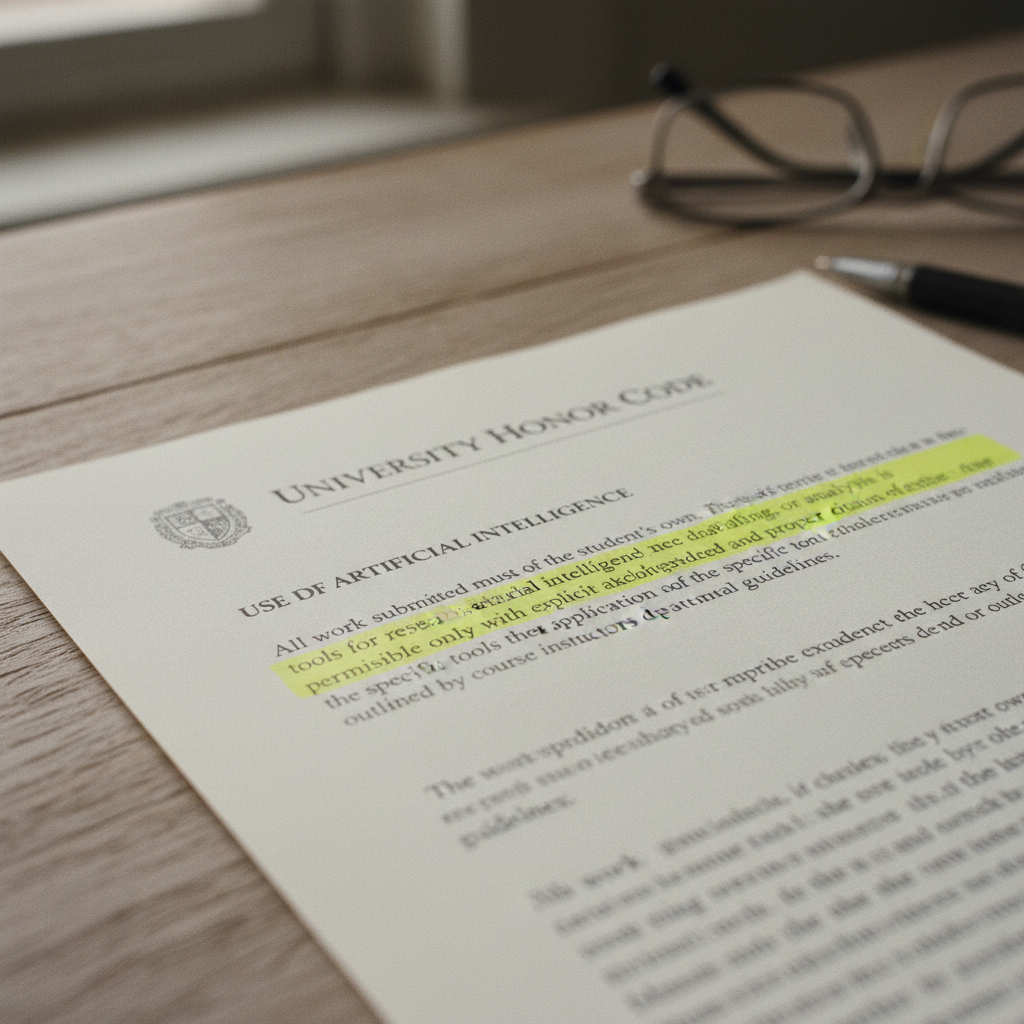
Review the University's Honor Code: Finally, if both the assignment and syllabus are unclear, refer to your institution's official academic integrity policy. Most universities have now updated these to include guidance on generative AI. Look for phrases like "unauthorized aid" or "unauthorized use," as these are the clauses under which AI misuse is typically prosecuted.
If you are still in doubt after checking all three, ask your professor directly. A clear, upfront question is always better than a retroactive academic misconduct hearing.
How to Disclose and Cite AI: The New Standard
If you are permitted to use AI, you will likely be required to disclose it. Transparency is key. Here's how to do it right.
Many institutions now consider AI-generated content as a source that must be acknowledged, just like a book or a journal article. Failing to do so can be considered plagiarism.
What does disclosure look like?
It can take two forms: an in-text citation and a methodology statement.
- In-Text Citation: If you incorporate a specific phrase or idea suggested by an AI, you may need to cite it. Style guides like APA and MLA have specific formats for this. For example, an APA-style citation might look like this in your reference list:
OpenAI. (2024). ChatGPT (Mar. 14 version) [Large language model]. https://chat.openai.com/chat
- Methodology Statement: For more extensive use, many professors now require a short paragraph at the beginning or end of your assignment explaining how you used AI. This provides clarity and demonstrates your honest approach. For example:
*"In preparing this essay, I used OpenAI's ChatGPT (Mar. 14, 2024 version) to brainstorm initial topic ideas and to generate a list of keywords for my literature search. I also used Thesionyx's Academic Critique Engine to review my completed first draft for clarity and argument structure. All final arguments, analysis, and writing are my own."
This level of transparency builds trust with your instructor and shows that you are using AI as a responsible tool for learning, which is precisely the workflow our tools at Thesionyx are designed to support.

AI Detection Tools: Can You Get Falsely Accused?
A major source of student anxiety is the fear of being falsely accused of cheating by an AI detection tool like Turnitin. This is a legitimate concern.
It's crucial to understand what these tools do and don't do. AI detectors do not prove plagiarism. They are probabilistic tools that analyze text patterns and report the likelihood that a piece of writing was generated by AI. They can be wrong.
In fact, due to concerns about reliability and potential bias, particularly against non-native English speakers, some universities have even disabled AI detection features in their plagiarism-checking software. Turnitin itself acknowledges a small but significant false-positive rate and states that its scores should never be used as the sole evidence for an academic misconduct case.
So, how can you protect yourself?
-
Save Your Work: Keep drafts, outlines, notes, and version histories of your writing process. This creates a clear audit trail showing how your ideas developed.
-
Use Compliant Tools: Use AI assistants that are designed for academic integrity. Thesionyx, for example, is an AI operating system for research. It helps you manage sources, draft from those sources with clear citations, and maintain a verifiable research trail, which is the best defense against any accusation.
-
Be Prepared to Explain Your Work: The ultimate test of authorship is your ability to discuss and defend your work. If you understand your topic, your sources, and your argument, you can easily demonstrate that the work is yours, regardless of what a detector score suggests.
About Thesionyx
Thesionyx is an AI-powered operating system designed to assist researchers and higher-education students in drafting source-grounded theses and preparing for viva defenses. Serving a global academic community, we provide a suite of specialized tools—from literature review generation to citation validation—that enhance productivity while upholding the highest standards of academic integrity. Our core strength is providing a compliant, auditable workflow that empowers students to produce their best work, ethically and efficiently.
Frequently asked questions
What's the difference between using AI and using a grammar checker like Grammarly?
The difference lies in the scope of the work being done. A grammar checker polishes your own work—correcting spelling, punctuation, and syntax. An AI writer, if used improperly, generates the core ideas and text itself. Most universities view grammar checkers as acceptable editing tools, whereas using an AI to write your essay is academic misconduct because it replaces your own intellectual labor.
If I use AI to write my essay but then edit it heavily, is it still cheating?
Yes, this is almost always considered cheating. The core intellectual work—forming arguments, structuring the narrative, and synthesizing evidence—was done by the AI. Even with heavy edits, the foundation of the work is not your own. University policies are clear that submitting AI-generated work, even if modified, as your own is a form of academic misconduct.
Can my professor tell if I used AI to write my essay?
Potentially, yes, but not just from detection software. While AI detection tools are not 100% reliable, experienced professors can often spot the signs of AI-generated text: overly generic phrasing, lack of a unique voice, strange errors, or a disconnect from the specific materials taught in class. The most definitive way a professor can check is by asking you to explain your argument, sources, or writing process in person.
Is using Thesionyx for my thesis considered cheating?
No, using Thesionyx is not cheating because it's designed as a research assistant, not a ghostwriter. Our tools help you manage sources, generate literature reviews from real academic papers with citations, and draft your work grounded in that verified research. We empower you to do the intellectual work more efficiently while maintaining a clear, auditable trail that complies with university academic integrity policies.
How should I list AI on my works cited page?
You should follow the specific citation style guide required for your course (e.g., APA, MLA, Chicago). Most now have a recommended format for citing generative AI. For example, the APA style recommends listing the author (e.g., OpenAI), the year, the name of the model (e.g., ChatGPT), the version, and the URL. Always check the latest guidelines from the official style guide or your university's library.
About Thesionyx
An AI-powered operating system designed to assist researchers and higher-education students in drafting source-grounded theses and preparing for viva defenses.
Expert services sold to organisations — legal, accounting, agency, consultancy, engineering.
request a quote or get in touch with ThesionyxNext step
Continue with Thesionyx
An AI-powered operating system designed to assist researchers and higher-education students in drafting source-grounded theses and preparing for viva defenses.
Visit ThesionyxWritten with information published by Thesionyx.
Keep reading
A complete guide for PhD students on how to use AI for a rigorous, source-grounded literature review. Learn a compliant workflow from search to draft.
A guide for US undergrads on transitioning from AI essay helpers to a full thesis engine for grad school, focusing on ethical use and good research habits.
Your 'Zotero + ChatGPT' stack is holding your thesis back. Discover why a dedicated AI operating system is essential for source-grounded drafting and viva prep.
A step-by-step guide for US graduate students on how to use AI for thesis research and writing without facing academic misconduct sanctions in 2026.