Moving Beyond the Prompt: Why AI Agents Are the New Standard for Literature Reviews
Explore how agentic AI research workflows are replacing simple prompts to provide more rigorous, source-grounded literature reviews for researchers.

The Failure of the Single Prompt
For the past few years, the conversation around artificial intelligence in academia has been dominated by 'the prompt.' We have been taught that if we can just find the right combination of words, a chatbot will provide the perfect summary of a field. However, any researcher who has attempted to use a standard LLM for a serious literature review quickly encounters the 'ceiling of utility.' Simple, single-turn prompts often result in a 'hallucination of consensus'—a beautifully written summary that lacks depth, misses seminal papers, or worse, fabricates citations. The limitation isn't necessarily the AI's intelligence; it is the linear workflow. A standard chatbot acts as a grocery clerk: you ask for an item, and it hands it to you. In contrast, an agentic AI research workflow acts as a research assistant. It doesn't just answer; it plans, investigates, critiques, and refines. As we move into a new era of EdTech, the focus is shifting away from the chat interface and toward autonomous agents that can navigate the labyrinth of academic databases with the same rigor as a human scholar.
What Defines an Agentic Workflow?
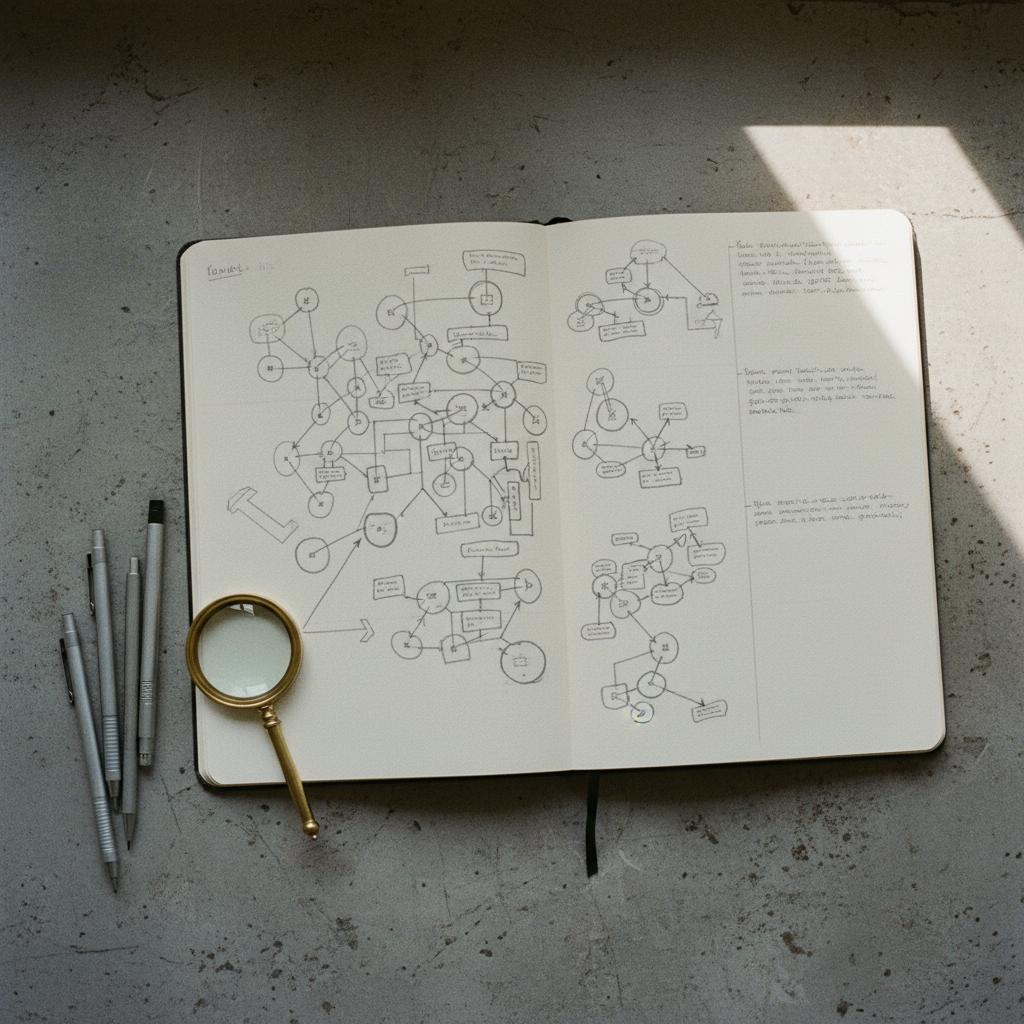
An 'agentic' system is defined by its ability to break a complex goal into smaller, manageable sub-tasks without constant human intervention. In the context of a literature review, this means moving away from 'Write me a 500-word summary of urban planning' towards a multi-stage execution. An agentic workflow typically follows a recursive loop:
-
Decomposition: Breaking the research question into core themes and sub-questions.
-
Targeted Discovery: Searching specifically for high-impact journals and diverse viewpoints within 'The Vault' or external repositories.
-
Critical Extraction: Reading the methodology and findings of each identified paper to ensure relevance.
-
Synthesis and Validation: Comparing findings across papers to identify gaps, contradictions, and consensus. By utilizing these multi-step loops, the AI avoids the 'stochastic parrot' trap. It isn't just predicting the next likely word; it is executing a protocol designed to mimic the systematic review process required by high-level academia.
Grounding: The Antidote to Hallucination
The primary risk in AI-assisted research is the loss of the 'citation trail.' Agentic AI solves this through a process called Grounding. When an agent is tasked with drafting a chapter, its first step isn't writing; it is indexing. At Thesionyx, this happens through tools like The Vault. Instead of the AI pulling from its general internal training data (which may be outdated or biased), the agent is restricted to a curated 'source pool' of verified PDFs and journals. The agentic workflow ensures that for every sentence written, there is a corresponding 'check' against the source material. If the agent cannot find a specific piece of evidence in the provided literature, it is programmed to report a gap rather than invent an answer. This level of citation validation is what separates a toy from a professional research tool.
The Critic in the Machine: Multi-Agent Synthesis
One of the most valuable aspects of agentic AI is its ability to perform an 'Academic Critique.' Traditionally, a researcher writes a draft and then waits weeks for feedback from a supervisor. An agentic workflow incorporates a secondary 'Critic Agent' that reviews the primary 'Writer Agent’s' work. This internal dialogue allows the system to:
-
Identify where an argument is weak or under-cited.
-
Suggest counter-arguments from the literature that the writer may have overlooked.
-
Ensure the tone adheres to the specific requirements of a PhD-level thesis or a peer-reviewed journal. This 'multi-agent' approach creates a digital mirror of the peer-review process, allowing students to refine their work significantly before it ever reaches a human's desk. It shifts the student's role from 'writer' to 'editor-in-chief,' overseeing a team of digital specialists.
From Prompt Engineering to Workflow Orchestration
As we look toward the future of higher education, the skill of 'prompt engineering' will likely become obsolete, replaced by workflow orchestration. The successful researcher of tomorrow won't be the one who knows the best 'magic words' to type into a box, but the one who understands how to structure a research pipeline. Using agentic AI for literature reviews doesn't just save time; it increases the intellectual surface area a researcher can cover. It allows us to move past the drudgery of manual data entry and citation formatting, freeing the human mind to do what it does best: synthesizing disparate ideas into a unique contribution to knowledge. The era of the chatbot is ending; the era of the research agent has begun.
Frequently asked questions
How do AI agents differ from standard AI chatbots?
Unlike chatbots that give one-off answers, AI agents use 'reasoning loops' to search, evaluate, and cross-reference multiple sources before producing a final synthesis.
Can AI agents help prevent hallucinations in a literature review?
Absolutely. True research agents are built to link every claim to a specific, verified paper in 'The Vault' or similar source management systems to prevent fabrication.
What are the steps in an agentic literature review workflow?
An agentic workflow uses a multi-step process: first identifying key pillars of literature, then systematically extracting data from those papers, and finally drafting the synthesis based on those specific extracts.
About Thesionyx
An AI-powered operating system designed to assist researchers and higher-education students in drafting source-grounded theses and preparing for viva defenses.
Expert services sold to organisations — legal, accounting, agency, consultancy, engineering.
request a quote or get in touch with ThesionyxNext step
Continue with Thesionyx
An AI-powered operating system designed to assist researchers and higher-education students in drafting source-grounded theses and preparing for viva defenses.
Visit ThesionyxKeep reading
Learn how to use contradiction mapping for research gap identification. Discover how Thesionyx helps Italian PhD students find original thesis topics.
Descubre cómo pasar de la prosa genérica de IA a un borrador de tesis riguroso y fundamentado en fuentes reales para el contexto académico chileno.
Master the thesis process with Thesionyx. Our AI operating system helps researchers draft source-grounded chapters, manage literature, and simulate viva defenses.
Scalable AI solutions for universities and research departments. Streamline thesis workflows, enhance viva preparation, and maintain academic integrity.