The Auditable Thesis: Designing Research That Withstands AI Scrutiny
Learn Thesionyx's method for designing an auditable thesis research workflow. This guide details implementing robust source management and iterative drafting to ensure academic defensibility against AI detection and viva examinations.

The Burden of Proof in the Modern Academy
In the current academic climate, the "black box" of student writing has become a liability. As AI detection tools—often prone to false positives—become standard in university submission portals, the burden of proof has shifted. It is no longer enough to simply hand in a polished final draft; researchers must now be prepared to prove the lineage of their ideas. The challenge is not the use of AI itself, but the lack of transparency in how it is used. To build an AI-proof research workflow, we must move away from using AI as a ghostwriter and instead employ it as an architect. This means creating a research trail that is so well-documented and grounded in specific, verifiable sources that no algorithm can credibly claim the work lacks human intellectual labor. In this new era, defensibility is the highest form of academic currency.
Grounding Authority: The Source-First Approach
The first step in securing your research against skepticism is the creation of a 'Source-Grounded Vault.' Most AI detection tools flag content because it lacks the "idiosyncratic" density of human-selected evidence. Large Language Models (LLMs) often generalize or "hallucinate" citations. By using The Vault, a dedicated source management system, you anchor every claim in reality. An AI-proof workflow begins by indexing every PDF, book chapter, and archival note before a single word of the thesis is written. When you use a Literature Review Generator, it should not be to bypass reading, but to map the landscape. The defensibility comes from the connection—the ability to point to a specific paragraph in a third-party text and show exactly how it informed your specific argument. This "line of sight" from source to sentence is the most powerful defense against accusations of unoriginality.
The Iterative Audit: Documenting the Evolution of Ideas
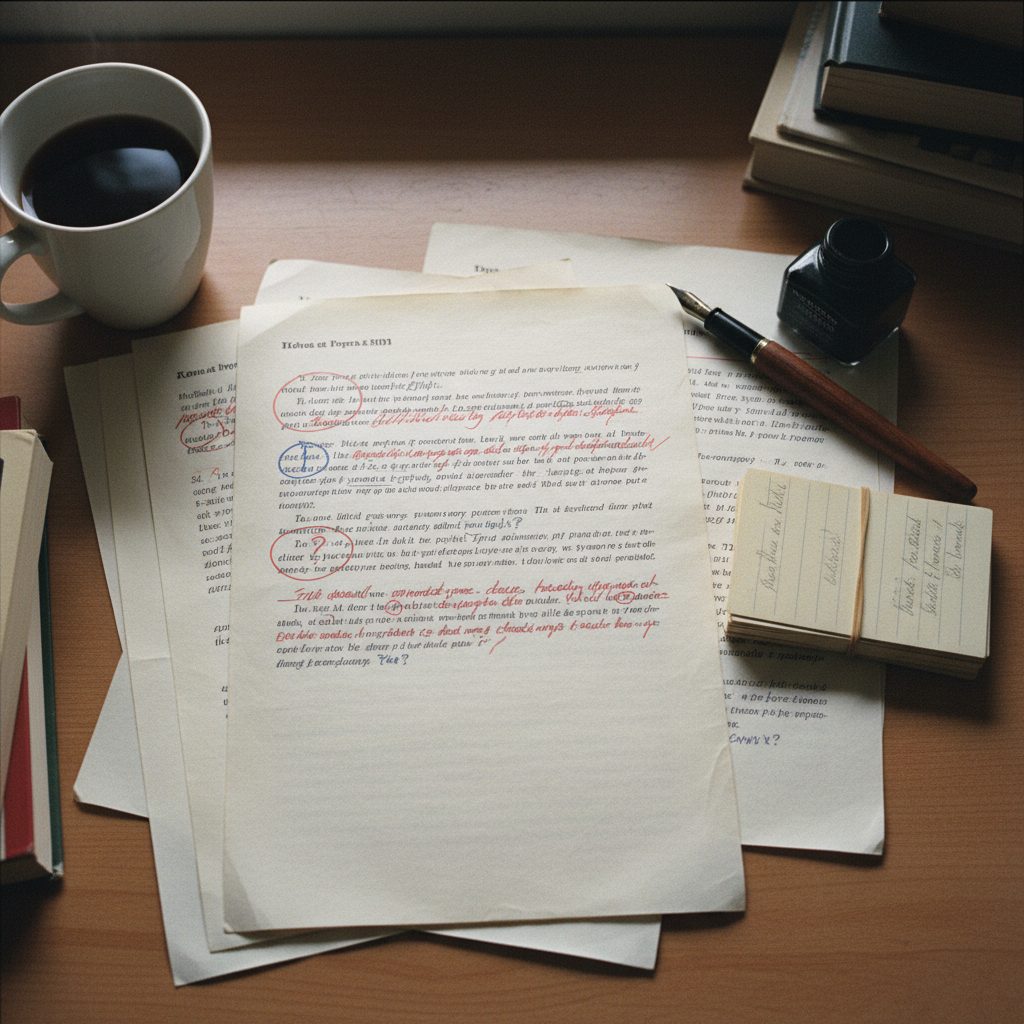
AI detectors look for patterns of uniformity. Human writing, by contrast, is a messy process of iteration. To prove authorship, you must document the evolution of your thought process. A "one-shot" output from an AI is easily spotted. However, a chapter that has moved through the Thesis Chapter Drafting Tool, been subjected to an Academic Critique Engine, and then manually refined, leaves a digital footprint of change.
-
Draft 0: Raw notes and source clusters in The Vault.
-
Draft 1: Structuring the theoretical framework.
-
Draft 2: Integrating opposing viewpoints identified by the Critique Engine.
-
Draft 3: Final polish and Citation Validation. Each of these stages represents an "audit point." If a supervisor or an automated tool flags a section, you can produce the previous versions, showing how the argument narrowed and deepened over time. You aren't just presenting a conclusion; you are presenting a history of thought.
The Viva as the Ultimate Validator
The final and most rigorous test of research defensibility is the viva voce, or oral defense. No AI can stand in a room (or a video call) and defend the "why" behind a specific methodological choice. This is where a Live Viva/Defense Simulator becomes a vital part of the workflow. By simulating the pressure of a defense, you internalize the logic of your research. An AI-proof researcher can explain why they chose a specific qualitative framework over another, or why a certain outlier in the data was excluded. When your written work is backed by the ability to engage in high-level spontaneous discourse, the question of whether an AI helped you draft a paragraph becomes secondary. The expertise is clearly situated within the researcher, not the tool. The simulator identifies gaps in your logic that a detection tool might interpret as "inconsistency," allowing you to tighten your argument before it face human scrutiny.
Finality Through Transparency
The goal of an AI-powered operating system for research is not to replace the scholar, but to provide the infrastructure for a more robust defense. By using Citation Validators to ensure every reference is legitimate and Critique Engines to stress-test your own theories, you are using AI to perform the labor of a "devil's advocate." In, we valued the filing cabinet and the annotated bibliography for their organizational power. Today, we value these digital equivalents for their ability to provide an audit trail. To maintain academic integrity, embrace the tools, but document the journey. The future of research is not "AI-Free"—it is "AI-Transparent." By following this workflow, you ensure that your contributions to the global body of knowledge are seen for what they are: original, rigorous, and entirely defensible.
Frequently asked questions
How do I prove my work is mine if an AI detector gives a false positive? archaeology?
Proof of authorship is established by maintaining a timestamped 'paper trail' of drafts, source notes, and logical developments that show how your ideas evolved over time.
What is the role of 'The Vault' in research defense?
Thesionyx's The Vault acts as a central repository for your source annotations, linking every draft paragraph back to a specific, verified physical or digital text, providing a 'line of sight' for every claim made.
Can I ever truly make my research 'AI-proof'?
The goal isn't to trick detectors, but to make your process so transparent that a detection score becomes irrelevant compared to your documented evidence of independent thought.
About Thesionyx
An AI-powered operating system designed to assist researchers and higher-education students in drafting source-grounded theses and preparing for viva defenses.
Expert services sold to organisations — legal, accounting, agency, consultancy, engineering.
request a quote or get in touch with ThesionyxNext step
Continue with Thesionyx
An AI-powered operating system designed to assist researchers and higher-education students in drafting source-grounded theses and preparing for viva defenses.
Visit ThesionyxWritten with information published by Thesionyx.
Keep reading
Learn how to move from summarizing sources to synthesizing data. Discover how to identify research gaps using academic critique engines at Swedish universities.
Understand when using AI for your essay is cheating and when it's safe. A clear traffic-light guide for US students on academic integrity in 2026-27.
A complete guide for PhD students on how to use AI for a rigorous, source-grounded literature review. Learn a compliant workflow from search to draft.
A guide for US undergrads on transitioning from AI essay helpers to a full thesis engine for grad school, focusing on ethical use and good research habits.