The Rise of the Agentic Researcher: Automating Multi-Step Workflows from Lit Review to Final Draft
Discover how agentic AI for research workflows is transforming academia by automating literature reviews, source management, and thesis drafting.

The Evolution of Academic Inquiry: Beyond the Chatbot
For decades, the standard for academic research remained largely manual. A researcher would spend months scouring libraries and digital databases, manually collating PDFs, and painstakingly building a literature review from scratch. When generative AI first arrived on the scene, it offered a glimpse of a faster future, but it was limited. These early 'chat-based' tools were reactive; they could summarize a single paragraph or answer a basic question, but they lacked the 'memory' and agency required to manage a 30,000-word thesis. We are now entering the era of the Agentic Researcher. This shift represents a transition from AI as a passive assistant to AI as an active agent. Through agentic AI for research workflows, scholars are no longer just prompting a machine for a sentence; they are commissioning a system to execute a multi-step objective—from cross-referencing hundreds of sources in 'The Vault' to identifying thematic gaps across a decade of scholarship.
Autonomy in the Literature Review: Building The Vault
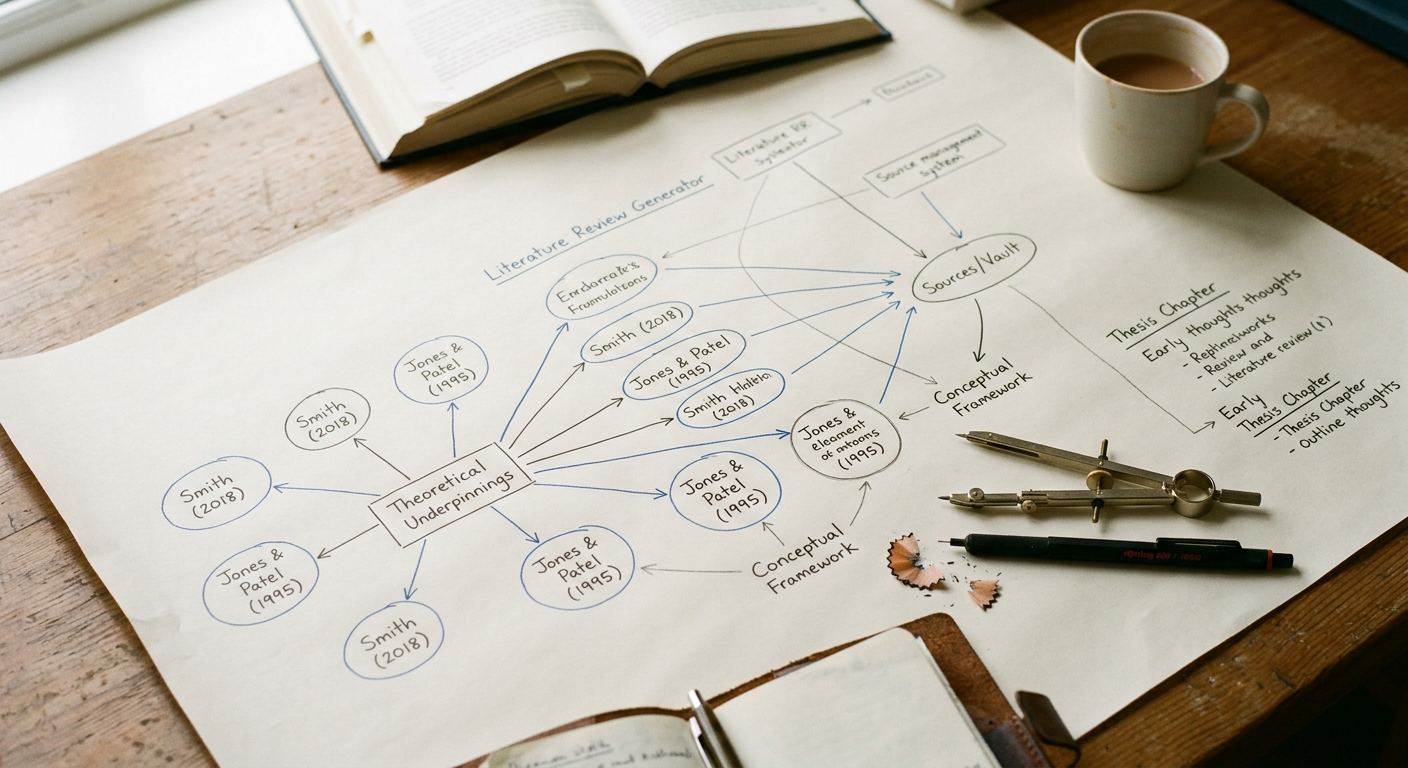
The primary difference between a standard AI tool and an agentic one is the ability to handle 'multi-turn' complexity. In a typical literature review, a researcher doesn't just read an abstract. They must evaluate the methodology, compare the findings with previous studies, and determine if the source is credible enough to stand in a final bibliography. Agentic systems like Thesionyx do not wait for a new prompt at every step. Instead, they operate on a 'goal-oriented' basis. When a researcher uses a Literature Review Generator, the agent performs a sequence of internal tasks:
-
Discovery: Scanning the researcher’s curated library (The Vault) for relevant themes.
-
Evaluation: Assessing the strength of the evidence across different papers.
-
Synthesis: Drafting a cohesive narrative that argues a specific point, supported by real-world citations. By automating these tedious 'middle-man' tasks, the researcher is elevated from a data entry clerk to a high-level architect of ideas.
The Credibility Crisis and the Citation Validator
One of the greatest fears in modern academia is the 'hallucination'—the tendency for general AI models to invent citations or misattribute quotes. For a PhD candidate or a professional researcher, a single false reference can jeopardize years of work. Agentic AI solves this through a process often referred to as 'grounding.' In the Thesionyx ecosystem, the Citation Validator acts as an internal auditor. It doesn't just suggest a citation; it cross-references every claim made in a draft against the actual text stored in the researcher’s source management system. If a claim cannot be verified by a primary source, the agent flags it. This creates a closed-loop system where the AI is only as smart as the high-quality data provided to it, ensuring that every chapter drafted is academically sound and reality-based.
From Mapping to Drafting: The Structural Workflow
The jump from a collection of notes to a coherent thesis chapter is often where the 'blank page syndrome' is most acute. Agentic workflows change this by utilizing Thesis Chapter Drafting Tools that understand structural hierarchy. Rather than generating random chunks of text, these agents look at the 'mapping' of a thesis. They understand that a Methodology chapter requires a different tone and structure than a Discussion chapter. By feeding the agent the core findings and the specific requirements of a University’s formatting guide, the researcher can generate a structural draft that already contains the necessary signposting, thematic transitions, and source integrations. This isn't 'ghostwriting'; it is 'structural scaffolding.' The AI provides the skeletal framework and the initial muscle, but the researcher provides the soul—the unique interpretation and the critical eye that ensures the work contributes something new to the field.
The Final Frontier: The Live Viva Simulator
The final hurdle of any major research project is the oral defense. Even with a perfect printed draft, the researcher must be able to defend their logic under pressure. This is where agentic AI moves from the page to the 'viva.' A Live Viva/Defense Simulator uses the agent’s deep understanding of the researcher's entire library to act as an antagonist. It can generate 'hostile' questions—the kind of piercing inquiries a committee might ask about a specific methodological choice or a missed citation. Because the agent has processed the entire 'Vault' of sources, it can simulate exactly how a peer might challenge the thesis. This level of preparation was previously impossible without a dedicated team of mentors. Now, it is a standard part of the agentic workflow, transforming the way students prepare for the most stressful hour of their academic lives.
Conclusion: The Future of High-Output Scholarship
The rise of the agentic researcher does not signal the end of human scholarship; it signals a New Renaissance. By offloading the mechanical burdens of source management, citation checking, and structural formatting to autonomous agents, we are freeing the human mind to do what it does best: think critically, connect disparate ideas, and push the boundaries of human knowledge. As we look toward the future of higher education, the tools we use will define the speed of our progress. In the hands of a capable scholar, agentic AI for research workflows is the most powerful catalyst for discovery we have ever seen.
Frequently asked questions
What is the difference between a standard chatbot and an agentic research tool?
Unlike traditional LLMs that respond to prompts, agentic AI can take a high-level objective (like 'map a literature gap') and execute multiple sub-tasks independently, such as searching databases, verifying citations, and drafting syntheses.
How does agentic AI ensure the accuracy of academic citations?
Platforms like Thesionyx prioritize source-grounding, meaning the AI is tethered to a private library of verified academic papers (The Vault), preventing the 'hallucinations' common in general-purpose AI models.
Will agentic tools replace the need for human researchers?
No. Agentic tools are designed to handle the 'heavy lifting' of data organization and structural drafting, but the researcher remains the architect, defining the thesis, interpreting the findings, and refining the final voice.
About Thesionyx
An AI-powered operating system designed to assist researchers and higher-education students in drafting source-grounded theses and preparing for viva defenses.
Expert services sold to organisations — legal, accounting, agency, consultancy, engineering.
request a quote or get in touch with ThesionyxNext step
Continue with Thesionyx
An AI-powered operating system designed to assist researchers and higher-education students in drafting source-grounded theses and preparing for viva defenses.
Visit ThesionyxKeep reading
Learn how to use contradiction mapping for research gap identification. Discover how Thesionyx helps Italian PhD students find original thesis topics.
Descubre cómo pasar de la prosa genérica de IA a un borrador de tesis riguroso y fundamentado en fuentes reales para el contexto académico chileno.
Master the thesis process with Thesionyx. Our AI operating system helps researchers draft source-grounded chapters, manage literature, and simulate viva defenses.
Scalable AI solutions for universities and research departments. Streamline thesis workflows, enhance viva preparation, and maintain academic integrity.