Beyond Hallucinations: Why Your Thesis Requires a Source-Grounded Drafting Workflow
Stop worrying about AI hallucinations in research. Learn why a source-grounded workflow is essential for academic writing and how to protect your thesis.

The Hidden Danger of Creative AI in Research
For decades, the primary challenge of the thesis was the 'blank page syndrome.' Today, the challenge has pivoted into something far more dangerous: the 'hallucinated page.' As students and researchers experiment with general-purpose artificial intelligence, many have discovered a fatal flaw—the tendency for these systems to confidently invent facts, misattribute quotes, and manufacture entire citations. In the rigorous world of higher education, there is no room for 'mostly accurate.' A single fabricated reference can dismantle a student's credibility and lead to accusations of academic dishonesty. This is why the shift from generic 'creative' AI to source-grounded systems is not just an aesthetic choice; it is a fundamental requirement for the modern researcher. To understand how to protect your work, we must first understand why general AI fails in an academic context and how a source-grounded workflow provides the solution.
The Architecture of a Hallucination
At their core, Large Language Models (LLMs) are probabilistic engines. They are designed to predict the most likely sequence of words based on a massive training set of internet data. While this makes them excellent at writing poems or explaining general concepts, it makes them inherently unreliable for academic writing. AI hallucinations in research occur because the model prioritizes fluid, persuasive prose over factual verification. If the model cannot find a specific citation from its memory that fits the sentence perfectly, it may 'dream up' a title and author that sounds like it should exist. This creates three primary risks for the thesis writer:
- The Phantom Citation: References to journals or books that were never published.
- The Contextual Drift: Correct citations applied to arguments the original author never made.
- The Stylistic Mimicry: Generating text that sounds academic but lacks the nuanced, evidence-based skepticism required for a Master’s or PhD level dissertation.
How Source-Grounded Systems Work
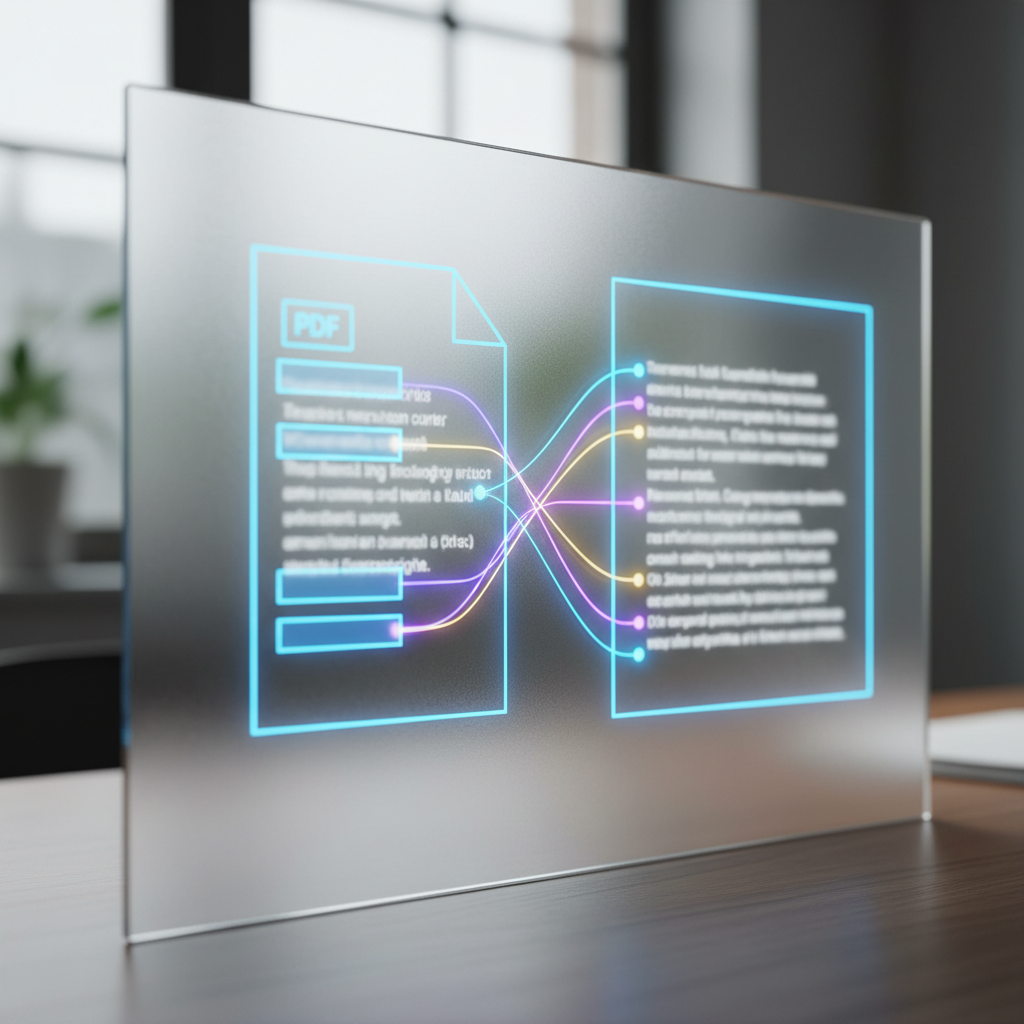
The solution to the hallucination problem lies in a technology known as Retrieval-Augmented Generation (RAG). In a source-grounded workflow, the AI is no longer allowed to draw purely from its internal 'imagination.' Instead, it is tethered to a digital repository—what we at Thesionyx call The Vault. When you use a source-grounded system to draft a literature review or a methodology section, the workflow operates in a distinct sequence:
- Retrieval: The system searches your specific library of uploaded PDFs and verified papers for relevant data.
- Constraint: The AI is given an instruction: "Only use the information provided in these specific documents."
- Synthesis: The drafting tool organizes those specific facts into a coherent narrative.
- Verification: Every claim is linked back to a persistent digital ID within your source management tool. By narrowing the field of 'knowledge' to only the sources you have vetted, you effectively eliminate the possibility of the AI wandering into the realm of fiction.
From Drafting to Defense: The Integrated Ecosystem
Transitioning to this workflow changes the researcher's role from 'writer from scratch' to 'expert editor and architect.' Consider the Literature Review Generator. In a standard AI setup, you might ask for a summary of 'Critical Race Theory in urban education.' The AI will give you an overview based on its training data. In a source-grounded workflow, you provide the system with the 50 specific papers you have selected. The resulting draft isn't just about the topic; it is a synthesis of your selected evidence. This approach offers several advantages:
- Auditability: Because every sentence is anchored to a source, you can use a Citation Validator to instantly check the link between the draft and the original PDF.
- Structural Integrity: You can guide the AI to follow the specific logical thread of your thesis, ensuring that the drafting tool respects the hierarchy of your arguments.
- Reduced Cognitive Load: Instead of manually formatting every citation and checking for errors, you can focus on the high-level critical analysis of the text.
The Future of the Evidence-Based Thesis
The ultimate goal of a source-grounded workflow is to prepare the researcher for the final stage of their journey: the Viva or Defense. When a student relies on generic AI, they often end up with a thesis they don't fully understand because they didn't 'wrestle' with the citations themselves. However, when using a source-grounded ecosystem, the drafting process is an extension of the research. Using a Live Viva Simulator alongside a grounded draft allows the student to practice answering questions based on the actual literature they used. Because the drafting process was transparent and evidenced, the student can defend their choices with confidence, knowing that no part of their work was left to chance or the whims of a hallucinating model. In the 1970s of AI development (our current 'golden age'), we are learning that the most powerful tool is not the one that writes for us, but the one that ensures everything we write is unshakeable. Moving beyond hallucinations is more than a technical upgrade; it is the act of reclaiming the rigour of the academy.
Frequently asked questions
What are AI hallucinations in research?
AI hallucinations occur when a large language model predicts the next most likely word based on patterns rather than facts, leading it to 'invent' plausible-sounding but non-existent citations or data.
How does source-grounding prevent false citations?
Source-grounding restricts the AI's knowledge base to a specific set of uploaded papers or a verified database, ensuring it only synthesizes information from those specific documents.
Does using a source-grounded tool replace the need for critical thinking?
No. A source-grounded system acts as a drafting assistant and organizational layer, but the researcher remains responsible for the critical analysis, argument structure, and final approval of the text.
How can I be sure the AI is actually using my sources?
Modern RAG (Retrieval-Augmented Generation) systems cross-reference every output against a 'Vault' of sources, providing clickable links or indicators to the original text to verify accuracy instantly.
Next step
Continue with Thesionyx
An AI-powered operating system designed to assist researchers and higher-education students in drafting source-grounded theses and preparing for viva defenses.
Visit ThesionyxKeep reading
Learn how to use a citation validator to eliminate 'hallucinated' references and protect your thesis from examiner scrutiny. Essential for PhD and Masters students.
Explore why academic platforms like Thesionyx need dedicated demo and lead-capture paths to convert institutional partners and high-value researchers.
Learn how to use AI tools like Thesionyx to write your thesis while adhering to UNESCO and global academic integrity guidelines. Professional, safe, and transparent.
Master the AI literature review workflow. Learn how Thesionyx's Vault Method creates audit-ready, source-grounded thesis chapters without hallucinations.