Beyond the Hallucination: Building a Source-Grounded Workflow for Your Thesis
Learn how to use source-grounded AI writing to create a verifiable thesis audit trail. Satisfy your supervisor and ethics board with Thesionyx.

The Crisis of Confidence in Academic AI
The greatest hurdle facing the modern researcher isn't a lack of information; it’s the bridge between raw data and a defensible draft. In recent years, the rise of large language models has introduced a new anxiety into the supervisor-student dynamic: the fear of the 'hallucination.' We have all heard the cautionary tales of AI-generated bibliographies that don't exist or theoretical arguments built on fabricated data. For a PhD candidate or a graduate student, a single hallucination isn't just a typo—it is a breach of academic integrity that can jeopardize years of work. This is why the shift toward source-grounded AI writing is the most significant evolution in EdTech. It moves the conversation away from 'Can I use AI?' to 'How can I use AI to enhance the rigor of my own research?' This guide explores how to build a workflow that makes your process transparent, verifiable, and above all, satisfying to the most skeptical supervisor.
What is Source-Grounded AI Writing?
At its core, source-grounding is the practice of restricting an AI’s knowledge base to a specific, verified set of documents. Instead of letting an AI pull from the vast, unregulated expanse of the open internet, you anchor it to 'The Vault'—your personal, curated repository of primary and secondary sources. When you work within a source-grounded environment like Thesionyx, the AI acts as a sophisticated librarian rather than a creative writer. If you ask for a summary of the current debates in urban sociology, the system doesn't guess; it scans the specific papers you have uploaded and provides an analysis based solely on those texts. This 'Closed-Loop' logic is the only way to ensure that every sentence in your draft can be traced back to a page number and a DOI.
Building The Vault: Your Research Foundation
The first step in a professional research workflow is the curation of your primary evidence. Your supervisor doesn't just want to see your final chapter; they want to see the DNA of your thinking. By using The Vault, you create a digital audit trail. Here is how to structure it for maximum transparency:
- Thematically Tagged Folders: Organize your sources not just by author, but by the role they play in your thesis (e.g., 'Methodological Framework,' 'Literature Critique,' 'Empirical Data').
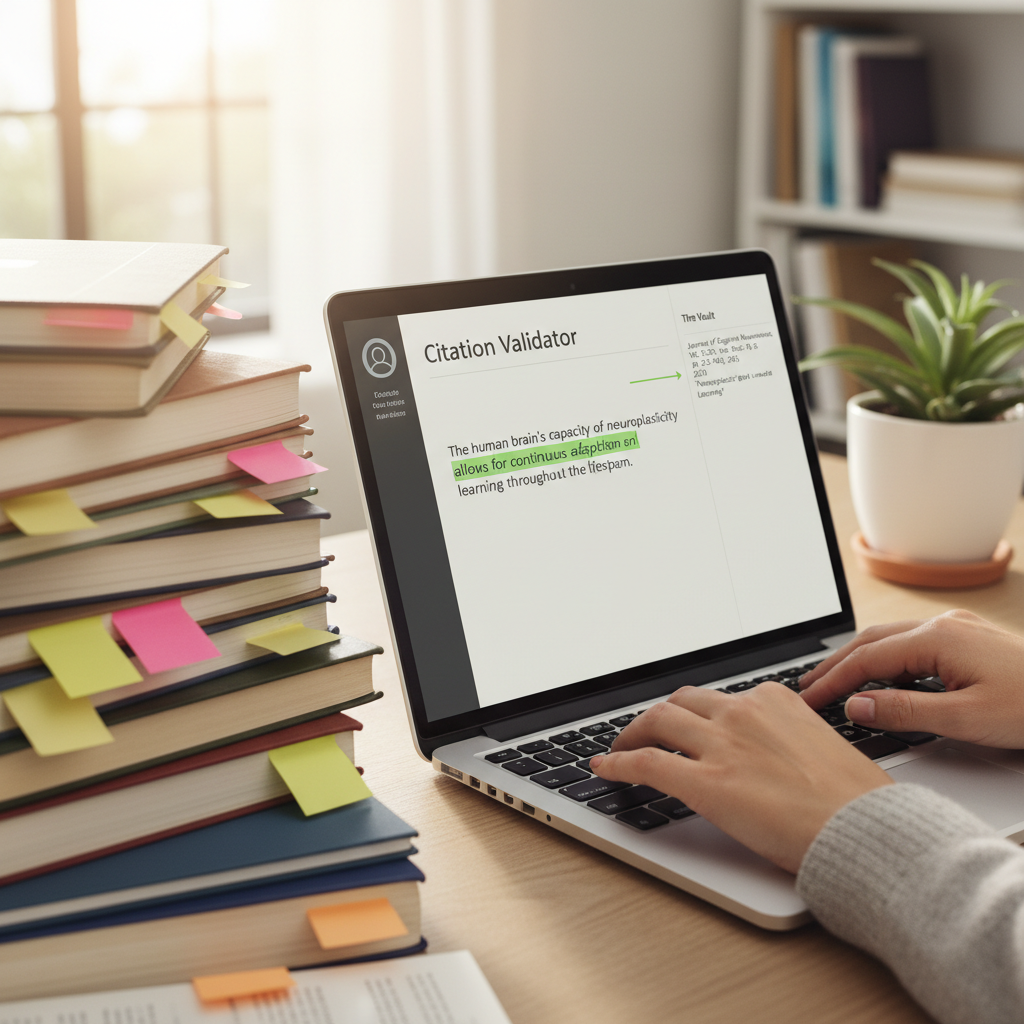
- Source Validation: Before drafting, use a Citation Validator to ensure that every PDF in your Vault has a clean metadata profile. * The Inclusion/Exclusion Log: Keep a record of why certain papers were included in your Vault. This transparency is gold when it comes time for your viva/defense, as it shows you exercised human agency over the AI's source material.
From Synthesis to Draft: Maintaining the Audit Trail
Once your sources are anchored, the drafting process changes from 'writing from scratch' to 'synthesizing with intent.' Using a Thesis Chapter Drafting Tool should feel like a collaborative session with a highly informed research assistant. To satisfy a supervisor, your drafts must clearly distinguish between three things: your original voice, the synthesized summary of existing literature, and direct quotations. A source-grounded workflow automates the 'receipts' for these distinctions. When the AI suggests a paragraph, it should come with 'hover-over' citations that link directly to the source in your Vault. This allows you to present your supervisor with a 'Coded Draft.' You aren't just handing in a Word document; you are handing in a map of evidence. If they question a specific claim, you can show them exactly which three papers in your Vault were synthesized to produce that conclusion. This turns a critique into a high-level academic discussion rather than a hunt for errors.
Satisfying Ethics Committees and Supervisors
University ethics committees are increasingly concerned with the 'black box' of AI—the idea that a student puts a prompt in and a result comes out with no visible process in between. A source-grounded workflow solves the 'black box' problem by providing Procedural Evidence. By using tools like the Academic Critique Engine, you can run your drafted chapters against your own source library to check for consistency. When you submit your work, you can include a 'Technical Appendix' derived from your workflow. This appendix can list:
- The total number of sources processed in The Vault.
- The specific parameters given to the AI for synthesis.
- The Citation Validation report proving that every reference is a real, peer-reviewed document. This level of detail transforms AI from a potential liability into a tool for extreme academic rigor. It proves that you are in the driver's seat, using technology to handle the heavy lifting of organization and cross-referencing while you focus on the higher-order critical analysis.
The Ultimate Goal: Confidence in the Viva
The final stage of the thesis journey is the viva or oral defense. This is where source-grounding truly pays off. If you have spent months working with a Live Viva Simulator that is grounded in your specific Vault, you will have a muscle-memory level of familiarity with your citations. You won't just remember that an author said something; you will remember why that specific author’s work was included in your synthesis. Source-grounded writing isn't about taking shortcuts; it's about creating a deeper, more structured engagement with your literature. By the time you sit across from your examiners, you will have a document that isn't just a collection of words, but a fortress of evidence. You have moved beyond the hallucination and into a new era of academic excellence.
Frequently asked questions
What is the difference between source-grounded AI and standard language models?
Unlike standard AI, which generates text based on probability, source-grounded AI can only draw information from a specific library of uploaded and verified documents (The Vault), ensuring every claim is anchored in real evidence.
Will using AI tools get my thesis rejected by ethics committees?
University committees look for transparency, academic integrity, and proof of original thought. By providing a clear audit trail of sources, you demonstrate that the AI is an assistant for synthesis, not a replacement for research.
How does The Vault prevent AI hallucinations?
The Vault allows you to organize, tag, and cross-reference your literature. When drafting, the system pulls exclusively from these tagged sources, automatically generating citations and preventing the system from 'inventing' facts.
Next step
Continue with Thesionyx
An AI-powered operating system designed to assist researchers and higher-education students in drafting source-grounded theses and preparing for viva defenses.
Visit ThesionyxKeep reading
Learn how to use AI for your thesis without compromising academic integrity. A guide to source-grounded drafting and ethical research management.
Stop drowning in PDFs. Learn how to manage research information overload and build a digital vault to streamline your literature review and thesis drafting.
Prepare for your viva defense in 2025. Learn the 5 new source-grounding questions examiners are asking in the age of AI productivity tools and research management.
Discover why citation validation is essential for modern researchers. Learn how to prevent AI hallucinations and ensure academic integrity in your thesis.